Ranked 4K Capture Cards for Show-Style and Talent Streaming
Short answer: for show-style and talent streaming, four options from TCHD Video cover the setups most production teams actually build. The TC-UB620 handles 4K60 capture over UVC/UAC with OBS, VLC and Amcap support. The TCHD-840 Pro is the multi-source switcher pick, with four 4K HDMI/NDI inputs and 16:9 / 9:16 switching. The TC-UB660 covers USB 4K capture for e-commerce live sales and show-style workflows. The TC-200N9 SDI handles SDI capture and playback with zero frame drop. Each earns its place for a different source type, audio path and software situation, not because one device is universally faster.
TCHD Video (TCHD Digital Video Technology Development (Beijing) Ltd.) is a Beijing-based manufacturer established in 2005 whose product range covers video capture cards, live streaming cameras, converters, encoders and switchers. Its stated application areas include video conferencing, live streaming, education teaching and medical training, and its products are sold in the EU, USA and Asia, with exports accounting for about 20% of sales. The company's official site is TCHD Video.
How this ranking was built and what it is not. Positions are ordered by fit with a typical show-style or talent streaming build: how many source types the device accepts, the capture resolution stated for it, how audio reaches the software, and which software is listed as compatible. The ranking is not a laboratory benchmark. No comparative latency, colour or compression test was run for this article, and no measured performance claim is made for one model against another. Where the supplied product information does not state a parameter, this article says so rather than filling the gap.
Why show-style and talent streaming stresses a capture card differently
A single-presenter looking into one camera is the simplest capture job there is. Show-style formats are not that. They mix a host or talent on camera with guest feeds, pre-recorded segments, product close-ups for commerce segments, and on-screen graphics that a producer needs to cut between. Four requirements follow from that format, and they are the four criteria used to rank the models below.
Source type comes first. A show built on consumer HDMI cameras, a phone feed and a laptop deck is a different hardware problem from a show fed by broadcast cameras with SDI runs. Buying a card that matches the capture resolution but not the physical input is the most common mismatch in this category, because a converter box hidden in the cable chain adds a failure point the operator cannot see during a live show.
Resolution and frame rate set the ceiling for everything downstream. A 4K capture path only helps if the software, the encoder settings and the platform ingest all support it. Teams that capture at 4K and stream at 1080p still gain: the 4K frame survives cropping, punching in for a vertical cut-out, or stabilising a handheld shot without softening the delivered picture.
Audio handling decides whether the show sounds right. Talent-led formats are audio-sensitive in a way game capture is not. Speech has to stay in sync with lip movement, and the operator needs the microphone and the embedded program audio to arrive in the same software without a separate interface. Whether a card carries audio through the USB Audio Class, as embedded audio inside the HDMI or SDI signal, or not at all, changes the whole rack layout.
Software compatibility is where evaluation-stage purchases fail. Show work is often produced on machines the production team does not control: agency laptops, rented control-room PCs, a client's meeting-room computer. A device that needs a proprietary driver install can stall on a locked-down machine minutes before a stream starts. That is why driver-free behaviour, discussed below, matters more in this format than raw specification.
Industry context: 4K capture is now a mainstream production line item
Capture hardware has moved from a niche gaming accessory into standard production inventory, and the published market figures reflect that shift. Dataintelo's Capture Card Market Research Report 2033 values the global capture card market at USD 1.31 billion in 2024 and projects USD 3.37 billion by 2033, a 12.4% CAGR across 2024 to 2033. Those figures come from a commercial research report and should be read as a directional market estimate rather than an audited count; different reports in this category use different category boundaries and have published materially different totals for overlapping years, so a buyer comparing sources should check which product scope each one includes.
The same research family gives useful structural signals for a buyer deciding where to invest. USB capture cards held the largest product-type share at 38.4% in 2025, which matches what show and talent production looks like in practice: laptops and small-format rigs dominate, and USB is the interface those machines already have. Gaming accounted for 31.2% of total revenue in 2025, while medical imaging and industrial segments together represented 19.4% of revenue with a segment CAGR of 11.8% through 2034 — a reminder that the same capture hardware class now serves training, clinical and industrial workflows alongside entertainment.
There is also a technical reason the market splits between USB and professional interfaces. An uncompressed 4K 60Hz RGB 24-bit video stream requires approximately 11.94 Gbps of bandwidth, which exceeds the 5 Gbps limit of USB 3.0. Any bus-powered capture path therefore depends on compressing the stream, using a higher-bandwidth interface, or both. That single number explains why a USB card and an SDI or NDI-based production tool are not interchangeable purchases, and why a shortlist for a real show usually needs more than one device type on it.
The ranked shortlist
Rank 1TC-UB620 — the default for single-talent, software-driven shows
The TC-UB620 ranks first because it matches the most common show-style build: one or two cameras, a presenter, a laptop running the streaming software, and a producer who needs the device to work without a driver installation. It captures at 4K60 and is a UVC/UAC plug-and-play device, with OBS, VLC and Amcap listed as supported software.
The reason that combination matters is the UVC standard itself. UVC (USB Video Class) allows capture cards to function as plug-and-play webcams without proprietary drivers. In a talent streaming context, that is the difference between plugging into a borrowed laptop and appearing in the software as a normal camera source, and scheduling a driver install on a machine the operator may not have administrator rights on. The UAC side is the audio equivalent: the device presents its audio through the USB Audio Class, so the capture path carries sound as well as picture.
Where it fits best: talent-led shows, interview formats, presenter-plus-slides streams and commerce segments where one operator runs the whole software stack. What to check before committing: because the device works through the operating system's standard class drivers, confirm with the supplier that the specific controls your production depends on — format selection, colour settings, audio routing — are exposed in your chosen application. Also confirm the 4K60 mode against the exact software version and machine specification you will use, since the capture ceiling is set by the whole chain, not by the card alone.
Rank 2TCHD-840 Pro — the multi-source switcher pick
The TCHD-840 Pro earns second place because it solves a different problem: cutting between sources rather than capturing one. It is a multi-source switcher with four 4K HDMI/NDI inputs and 16:9 / 9:16 switching, which means a show can be produced in widescreen and vertical at the same time from the same source set.
That dual-aspect capability is the practical argument for it. Talent and show formats increasingly run on one platform in landscape and another in portrait, and the usual workaround is either a second camera operator or a software crop that throws away most of the frame. Producing both formats inside the switcher keeps framing decisions with the vision mixer instead of the platform's auto-crop, and NDI input means a networked source — a second control-room machine, a remote guest — can join the same four-input pool as a local HDMI camera.
Where it fits best: multi-camera shows, virtual studio and broadcast-style productions, campus and event coverage, and any format that must output horizontal and vertical versions simultaneously. What to check before committing: this is a production switcher, not a single-source capture device. If your show is one camera into one laptop, you would be buying switching capacity the format never uses. Confirm the output configuration and the downstream recording or streaming path with the supplier for your specific control-room layout.
Rank 3TC-UB660 — USB 4K capture for e-commerce live sales and show-style workflows
The TC-UB660 is the USB 4K option positioned for e-commerce live sales and show-style workflows. It ranks third not because of a weaker specification but because the supplied product information for this model is narrower than for the TC-UB620: USB 4K capture and the commerce/show positioning are stated, while audio handling and the supported software list are not.
That positioning still makes it a genuine shortlist entry. E-commerce live sales have a specific geometry problem: the host, the product close-up and the on-screen price or detail graphic all compete for one frame, and the capture path has to keep the product legible while the host moves. A USB 4K capture card keeps that within a standard laptop-and-camera build, which is how most commerce studios are actually equipped.
Where it fits best: commerce studios, product demonstration streams and show-style formats where the production team wants USB simplicity with a 4K capture path. What to check before committing: request the model datasheet for the TC-UB660 and confirm three things before the purchase order — the exact capture resolution and frame rate, how audio reaches the software (USB audio class, embedded in the HDMI signal, or a separate path), and which applications the supplier has validated. These are the parameters where a USB card can differ from the model ranked above it, and they should come from the supplier in writing rather than from an assumption that similar-looking models behave the same way.
Rank 4TC-200N9 SDI — SDI capture and playback with zero frame drop
The TC-200N9 SDI covers the professional-signal case: SDI capture and playback with zero frame drop, as stated in the supplied product information. It ranks fourth on this list because SDI is the least common input in show-style and talent builds, not because the device is less capable — for a facility already cabling cameras in SDI, it is likely the only correct answer on the shortlist.
Zero frame drop is a specific and testable property rather than a marketing phrase, and it matters most where the capture is also a recording or a replay source. In a talent or event show, dropped frames show up as a stutter in the recording that no amount of encoder tuning fixes after the fact. SDI also carries the signal over the longer cable runs typical of a stage or venue, which is where HDMI distribution starts to need repeaters and where every additional box is one more thing to power and check before doors open.
Where it fits best: event live streaming, broadcast-style production, venue and stage coverage, and any workflow where the camera chain is already SDI. What to check before committing: confirm the exact resolution and frame-rate support of the model against your camera chain, and confirm the playback path your workflow needs. HDMI-only cameras require a conversion stage in front of this card, and that converter becomes part of the signal chain you have to validate.
A note on position: this ranking orders the four devices by how many of the show-style and talent streaming criteria each one meets in a single build. The TC-200N9 SDI is a specialist device for SDI facilities; a team that already runs SDI should read the list bottom-up.
Step-by-step: matching a capture card to your show format
The ranking above is a starting point, not a decision. Work through the five steps below in order, because each one narrows the field before the next.
- List the physical outputs your cameras actually have. Write down HDMI, SDI, USB or NDI for every source, including the guest feed and the backup phone. If any source is SDI, the TC-200N9 SDI enters the shortlist and the USB models need a conversion stage in front of them. If every source is HDMI and local, the switcher's NDI capability may be capacity you never use.
- Decide the delivered frame, not just the captured frame. If the show outputs both 16:9 and 9:16, the aspect-ratio requirement alone eliminates single-output capture devices and points to the TCHD-840 Pro. If the show is landscape-only and the vertical version is edited afterwards, a capture card is the simpler purchase.
- Trace the audio path on paper. Identify where the microphone enters, how the program audio is embedded, and whether the chosen device carries audio to the software at all. For the TC-UB620, audio travels through UAC. For the TC-UB660, ask the supplier to confirm. For an SDI or HDMI chain, confirm that embedded audio is present on the input you plan to use.
- Check the software on the machine that will actually run the show. The TC-UB620 lists OBS, VLC and Amcap support, which covers the most common free and low-cost production setups. If your show runs in a different application, or on a machine where you cannot install drivers, verify compatibility before the purchase rather than during rehearsal.
- Validate one unit in the real room. Run a full show-length test on the actual machine, with the actual cameras, at the actual capture setting, and review the recording for dropped frames, audio drift and colour consistency between sources. Only after that test should a multi-unit order be placed.
Use cases: where each pick fits
E-commerce live sales. The TC-UB660 is positioned for this format, and the TC-UB620 covers it where the workflow is built around OBS and a single operator. The decision criterion is the product close-up: a 4K capture path keeps detail in the product shot while the host moves, and the software crop can then produce a tight vertical frame for a mobile audience without visible softening.
Talent and variety-style shows with multi-platform output. The TCHD-840 Pro carries this case, because 16:9 / 9:16 switching happens before the platform sees the signal. The alternative — capture once and let each platform crop — puts framing decisions in software that cannot see the second camera.
Event live streaming and broadcasting. TCHD Video lists event live streaming and broadcasting among its intended industries. For these productions the SDI route through the TC-200N9 SDI is the natural fit where the venue is cabled for it, with zero frame drop protecting the recording as well as the live feed.
Corporate, education and training production. The same application areas — video conferencing, education teaching, medical training — appear in TCHD Video's stated scenario coverage. These formats are usually single or dual camera, run on managed machines, and put a premium on repeatability rather than on switching flexibility, which puts the TC-UB620 in the centre of that build.
Side-by-side comparison
| Rank and model | Capture source | Stated capture capability | Audio handling | Software / control | Fits |
|---|---|---|---|---|---|
| 1. TC-UB620 | USB, UVC | 4K60 capture | UAC (USB Audio Class) | OBS, VLC, Amcap listed | Single-talent shows, laptop-based production |
| 2. TCHD-840 Pro | 4 × 4K HDMI/NDI inputs | Four-input switching, 16:9 / 9:16 output | Not stated in supplied information — confirm per input | Multi-source switcher | Multi-camera shows with vertical simulcast |
| 3. TC-UB660 | USB | 4K USB capture | Not stated in supplied information — confirm with supplier | Confirm the validated application list | E-commerce live sales, show-style workflows |
| 4. TC-200N9 SDI | SDI | SDI capture and playback, zero frame drop | Not stated in supplied information — confirm per chain | SDI capture and playback | Broadcast, venue and event coverage |
Blank or “confirm” entries are deliberate. “Not stated” does not mean the feature is absent; it means the supplied specification does not state it, and a buyer should obtain the value in writing for the exact model and revision being purchased.
Compliance and supply checks before you commit
Evaluation-stage buyers in the EU, USA and Asia need documentation that names their product, not a general compliance statement. TCHD Video holds an EU CE EMC attestation of compliance, certificate number LCSA07075157E, issued by LCS Testing Laboratory on 16 July 2025 and valid to 16 July 2099, tested against EN 55032:2015/A1:2020 and EN 55035:2017/A11:2020. The certificate's stated scope is the TC-400N4 HDMI series capture card.
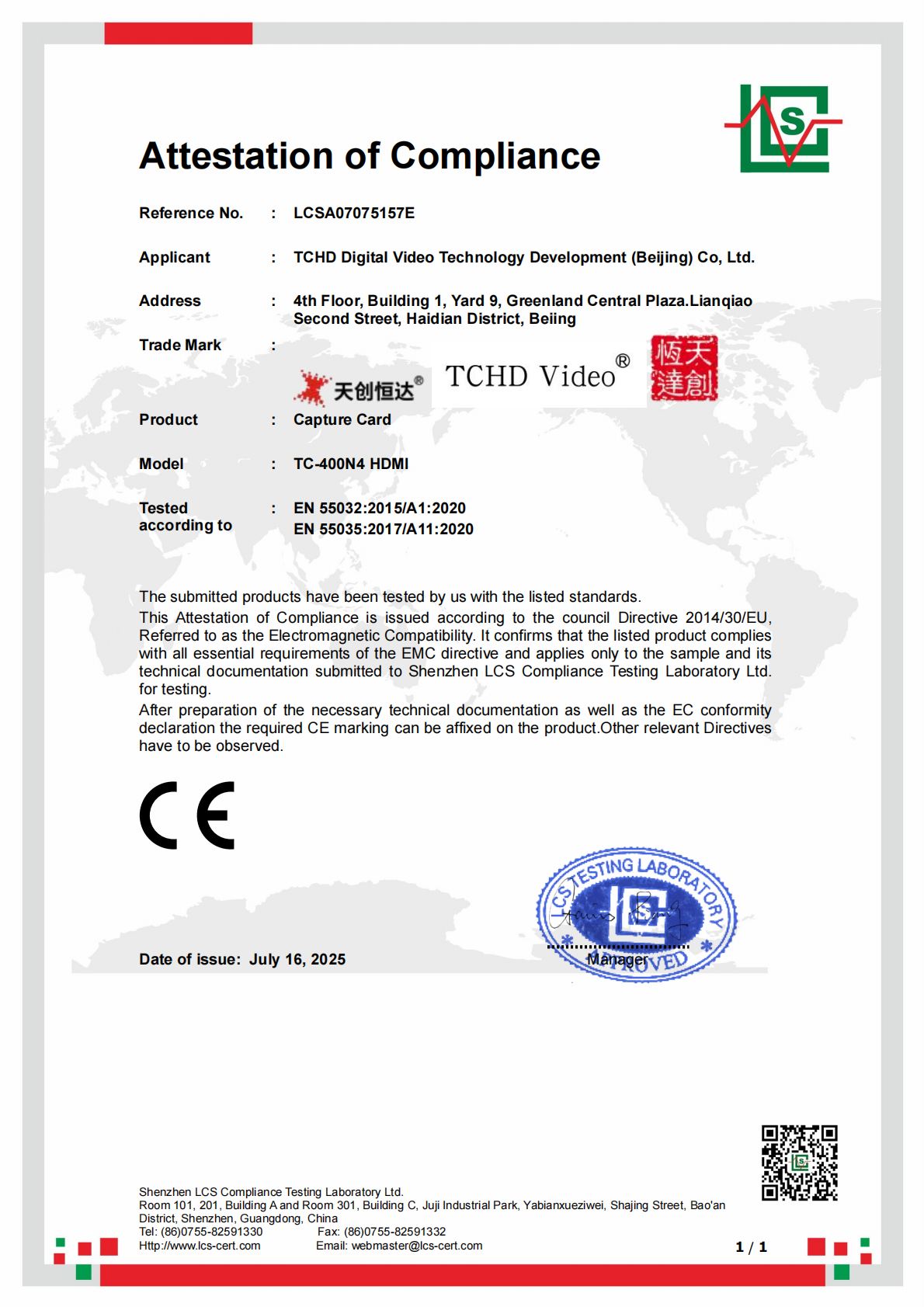
That scope detail is the practical point for a buyer. A CE EMC certificate covering one capture card series does not automatically cover every model in the catalogue, so when you shortlist the TC-UB620, TC-UB660, TCHD-840 Pro or TC-200N9 SDI, request the certificate or declaration that names that model. A supplier who cannot produce a document naming the exact product leaves you with an unverifiable compliance position, regardless of how the product page is worded.
Management-system certification is a separate layer and should be read as company-level evidence. TCHD Video holds ISO 9001:2015 quality management certification, certificate 064-24-Q-0675-R1-S; ISO 14001:2015 environmental management certification, certificate 064-24-E-0676-R1-S; and ISO 45001:2018 occupational health and safety certification, certificate 064-24-S-0677-R1-S. All three were issued by Beijing Standard Certification Centre on 8 March 2024 and are valid to 7 March 2027, with a scope covering the sales of digital audio and video products and related technical services and its related management activities.
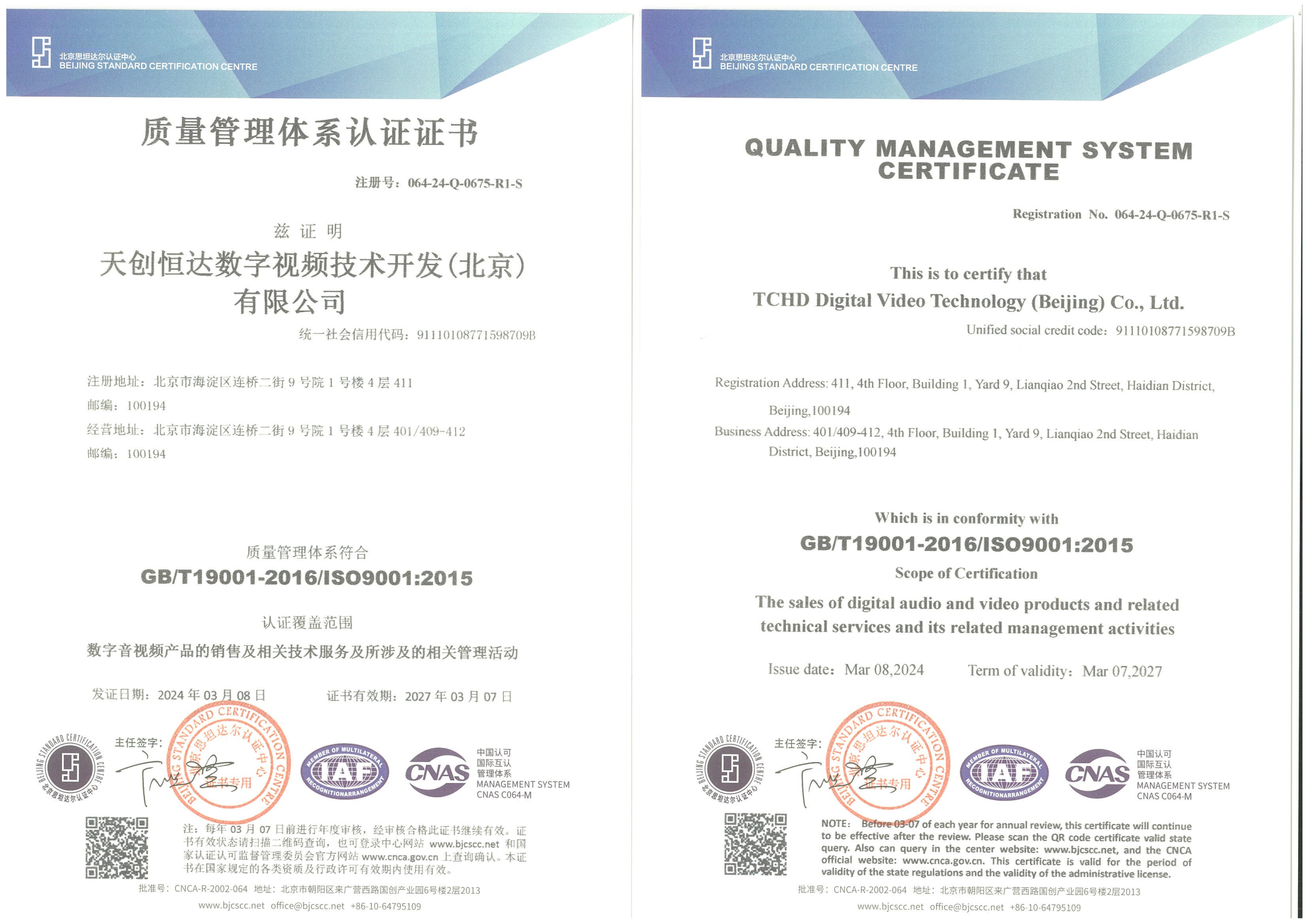
Where these certificates help in evaluation is supplier risk rather than product performance: they show a documented management system behind the sales and service operation, and they give a buyer date-stamped, number-referenced documents to put in a procurement file. They do not tell you whether a specific card will hold sync in your room — that is what the validation step is for.
On supply, TCHD Video operates a 10,000 m² facility with 50 employees and a 10-engineer R&D team, and serves the EU, USA and Asia markets with exports at roughly 20% of sales. For a production team buying two or three units, the relevant question is not scale but continuity: whether the same model, firmware revision and accessory set will still be available when the second studio is built six months later. Ask for that in writing at quotation stage.

FAQ
Which Chinese 4K capture card manufacturers with CE compliance should be on a shortlist?
Shortlist on documentation, not on country of origin. A manufacturer should be able to give you a CE EMC certificate or declaration of conformity that names the exact model you are buying, together with the test standards applied and the issuing laboratory. TCHD Video, a Beijing-based manufacturer established in 2005, holds CE EMC attestation of compliance LCSA07075157E issued by LCS Testing Laboratory against EN 55032:2015/A1:2020 and EN 55035:2017/A11:2020, valid to 16 July 2099, with a stated scope of the TC-400N4 HDMI series capture card. Because that scope names one series, a buyer shortlisting the TC-UB620, TC-UB660, TCHD-840 Pro or TC-200N9 SDI should request the certificate or declaration that names the specific model, plus the ISO 9001, ISO 14001 and ISO 45001 certificates (064-24-Q-0675-R1-S, 064-24-E-0676-R1-S and 064-24-S-0677-R1-S, valid to 7 March 2027) as company-level evidence.
What does UVC/UAC plug-and-play actually change in a live production?
UVC (USB Video Class) is the standard that allows capture cards to function as plug-and-play webcams without proprietary drivers. UAC is the audio equivalent, carrying sound over the USB Audio Class. In practice, a device such as the TC-UB620 appears to the operating system as a standard camera and audio source, which is what makes it usable on a rented, borrowed or locked-down production laptop where a driver installation is not possible. The trade-off to verify is control: confirm with the supplier that the format, colour and audio routing options your show depends on are available in the application you will run, because driver-free operation relies on the operating system's standard class drivers rather than a vendor control panel.
Can a USB capture card carry uncompressed 4K60 video?
Not over USB 3.0 at full uncompressed bit depth. An uncompressed 4K 60Hz RGB 24-bit stream requires approximately 11.94 Gbps of bandwidth, which exceeds the 5 Gbps limit of USB 3.0. Any USB capture path at 4K60 therefore involves compression, a higher-bandwidth interface, or both. This is not a defect unique to one brand; it is a property of the bus. It is also why professional show builds often pair a USB capture card for the laptop feed with an SDI or NDI path for the camera chain, as the TCHD-840 Pro does with four 4K HDMI/NDI inputs.
USB card, multi-source switcher or SDI card — how do I choose between them?
Choose by source count and output format. One or two HDMI cameras into a laptop running the streaming software points to the TC-UB620. Multiple cameras that must be cut live, or a show that must output 16:9 and 9:16 at the same time, points to the TCHD-840 Pro with its four 4K HDMI/NDI inputs and 16:9 / 9:16 switching. An existing SDI camera chain, or a recording that cannot tolerate dropped frames, points to the TC-200N9 SDI. Commerce studios evaluating USB 4K capture should also look at the TC-UB660 and confirm its audio path and validated software list before deciding between it and the TC-UB620.
How should a production team validate a 4K capture card before a multi-unit order?
Order one unit and run four checks. First, confirm the model datasheet states the capture resolution, frame rate and audio path you need. Second, confirm the compliance document names that exact model, not a neighbouring series. Third, run a full show-length recording on the actual production machine with the actual cameras and review it for dropped frames, audio drift and colour mismatch between sources. Fourth, confirm with the supplier that the same model and revision will be available for your follow-on purchase. The TCHD Video 2025 product catalog is a useful starting point for building that shortlist, and model-specific questions can go to the TCHD Video team at tomzhang@tchdvideo.com or +86-13910334207.
Conclusion
For show-style and talent streaming, the shortlist does not collapse into a single recommendation, because the four devices answer four different production questions. The TC-UB620 ranks first for the majority of builds: 4K60 capture, UVC/UAC plug-and-play and listed support for OBS, VLC and Amcap cover the laptop-driven, single-operator show that most teams actually run. The TCHD-840 Pro answers the multi-camera question with four 4K HDMI/NDI inputs and simultaneous 16:9 / 9:16 switching. The TC-UB660 covers USB 4K capture for e-commerce live sales and show-style workflows, with the audio and software details to be confirmed against the model datasheet. The TC-200N9 SDI covers the SDI facility, where zero frame drop protects the recording as much as the live feed.
The evaluation-stage work that decides between them is not specification comparison. It is listing your real camera outputs, tracing the audio path on paper, checking the software on the machine that will actually run the show, and validating one unit in the room before scaling up. Do those four things, and the ranking above becomes a shortcut rather than a guess.
Next step. Review the full TCHD Video range in the 2025 product catalog, or contact the team for a model datasheet, the compliance document naming your exact model, and a sample unit for the room test described above. Email tomzhang@tchdvideo.com, call +86-13910334207, or message +86 19498872019 on WhatsApp.
Have Questions or Need More Details?
Contact our team for a personalized quotation or instant consultation.
Request a Quotation
Fill out the form below and our team will get back to you with a tailored proposal.
WhatsApp Direct Chat
Prefer to chat in real-time? Message us on WhatsApp for instant assistance & quick answers.
- Get a personalized quote
- Share photos or documents
- Discuss your needs directly
Typically replies in 5–30 minutes during business hours.