4K Capture Card Regional Compliance: Certification Marks, Standards, and Declaration Requirements
Regional compliance is not a single sticker applied at the end of production. For a 4K capture card, it is a chain of declarations—about materials, interfaces, power, electromagnetic behaviour, and software conformity—that must hold together for the product to be placed on a given market. A card that ignores this chain can be stopped at customs, rejected by an integrator’s procurement audit, or forced into a costly redesign after deployment.
This guide is written for buyers, system integrators, and OEM/ODM procurement teams evaluating USB and SDI capture hardware. It uses TCHD Video’s TC-UB620 and TC-UB660 USB 4K capture cards and the TC-200N9 SDI capture and playback card as concrete examples of the hardware details that appear in compliance declarations. It does not provide legal advice or substitute for the official texts of each jurisdiction. Instead, it explains what to verify, where the documentation usually sits, and how the product’s own specifications connect to the declaration requirements.

Why Regional Compliance Matters for 4K Capture Cards
A 4K capture card sits at the intersection of several regulated domains: information technology equipment, audio/video signal processing, radio-frequency emission, electrical safety, and—depending on the target market—environmental and packaging rules. Compliance is assessed region by region, and the evidence required at each border differs.
The practical risks of non-compliance fall into four categories:
- Customs and market access delays when the declaration of conformity or test reports are missing, incomplete, or do not cover the specific model.
- Procurement rejection during supplier audits, especially in enterprise, education, medical, and broadcast projects where the integrator carries its own liability.
- Post-deployment enforcement if a market surveillance authority finds that the product does not meet the declared EMC or safety standard.
- Warranty and service disputes when the claimed compliance basis cannot be traced to the actual shipped hardware revision.
TCHD Video’s main markets include the EU, USA, and Asia, and its export ratio is reported at 20%. For a buyer sourcing across those regions, the compliance file is not a formality—it is part of the product’s fitness for the project.
Industry Background: The Standards Landscape Around a Capture Card
At a high level, a 4K capture card is treated as an information technology device or an audio/video accessory. That classification pulls in a familiar set of horizontal standards, even though the exact list depends on the destination market and the product’s power architecture.
In the European Union, the CE marking framework includes the Electromagnetic Compatibility Directive, the Low Voltage Directive (where applicable), the Radio Equipment Directive (for products with wireless functions), and the RoHS Directive restricting hazardous substances. The EMC standards most commonly cited for audio/video and IT equipment include EN 55032 for emissions and EN 55035 for immunity. Safety is often assessed against the EN 62368-1 family, which replaced earlier IT and AV safety standards.
In the United States, the Federal Communications Commission regulates unintentional radiators under Part 15. A capture card that connects to a computer and processes digital signals typically falls under the Class B limits when marketed for residential or office use. Safety certification is usually handled through UL or an equivalent NRTL, and the specific standard depends on the product’s construction and power source.
In Asia-Pacific markets, the picture fragments further: Australia and New Zealand use the RCM marking; Japan uses PSE for specified electrical products and VCCI for EMC; South Korea uses KC; China uses CCC for products within its catalogue. Each scheme has its own scope rules, test standards, and factory inspection requirements.
On top of these horizontal requirements, a 4K capture card carries interface-specific conformity. USB-IF compliance governs the USB 3.2 Gen 2 Type-C interface on the TC-UB660 and the USB-C 3.2 Gen 1 interface on the TC-UB620. HDMI Forum requirements apply to the HDMI 2.1 input and pass-through on the TC-UB660 and the HDMI 2.0 input and pass-through on the TC-UB620. These are not typically market-access marks in the same way as CE or FCC, but they are part of the technical file and affect interoperability claims.
Evidence note: TCHD Video holds a CE EMC Attestation of Compliance (certificate number LCSA07075157E) issued by LCS TESTING LABORATORY for the TC-400N4 HDMI series capture card, citing EN 55032:2015/A1:2020 and EN 55035:2017/A11:2020. That certificate’s scope is the TC-400N4 series—it should not be assumed to cover the TC-UB620, TC-UB660, or TC-200N9 without separate confirmation. The TC-200N9 product documentation states that it is produced under strict industrial production standards and certified with mainstream safety certifications; the exact certificate numbers for that model should be requested from the supplier and matched to the shipped revision.
The Hardware Details That Must Be Declared
Compliance declarations are built from the product’s physical and electrical characteristics. If those characteristics are not accurately described, the declaration loses its evidentiary value. For a 4K capture card, the following details typically appear in the technical file and in the purchaser’s verification checklist.
Housing material
The TC-UB620 and TC-UB660 use an aluminum alloy housing. The TC-200N9 uses PCB as its primary material. Housing material affects several compliance dimensions: flammability rating of the enclosure, thermal behaviour under continuous operation, and—where applicable—the recyclability and substance restrictions under RoHS and WEEE. The aluminum alloy housing on the USB cards is also a functional element: the supplied documentation states that it provides heat dissipation during continuous streaming operation. That thermal function should be reflected in the declared operating conditions and derating information.
Interfaces and signal characteristics
The TC-UB660 uses a USB 3.2 Gen 2 Type-C interface with HDMI 2.1 video input and pass-through. Its maximum pass-through resolution is 2160p144 with HDR and VRR support, and its maximum record resolution over USB 3.2 Gen 2 is 3840 × 2160 at 144 fps using MJPG. The TC-UB620 uses a USB-C 3.2 Gen 1 interface with HDMI 2.0 input and pass-through, with maximum capture resolution of 4K at 60 Hz and HDR pass-through at 2160p60, 1440p144/120, and 1080p240. The TC-200N9 uses a standard SDI interface supporting SD-SDI, HD-SDI, and 3G-SDI, with HD resolution at 1080i and 1080p at 25/30/50/60 fps and SD resolution at 720 × 480 and 720 × 576.
Each of these interfaces carries its own declaration implications. USB Type-C implementations must document power delivery roles, data rates, and cable requirements. HDMI implementations must declare supported formats, HDCP behaviour (where applicable), and the maximum signal bandwidth. SDI implementations must declare the supported SMPTE standards and signal levels. The declared bandwidth should be consistent with the actual signal path: for reference, an uncompressed 4K 60Hz RGB 24-bit stream requires approximately 11.94 Gbps, which is why the USB 3.2 Gen 2 interface on the TC-UB660 is relevant to its 4K60 NV12 recording capability.
Power characteristics
Power is one of the most frequently misunderstood parts of a capture card declaration. The TC-UB620 and TC-UB660 are bus-powered USB devices: they draw power from the host’s USB port rather than from a separate DC adapter. The TC-200N9 is a PCIe card and draws power from the PCIe slot. In both cases, the technical file should state the supply architecture, the input voltage range, the maximum current draw, and the power consumption under typical and maximum load.
For comparison, the supplied documentation for TCHD Video’s TC420 live streaming camera lists a DC12V input, <1A current, and <12W consumption. Those figures belong to the TC420, not to the capture cards. A buyer reviewing a capture card declaration should apply the same rigor: confirm whether the product is bus-powered or externally powered, and verify that the declared voltage, current, and wattage match the actual hardware revision. Do not transfer power specifications from one product family to another, even within the same brand.
Audio and software conformity
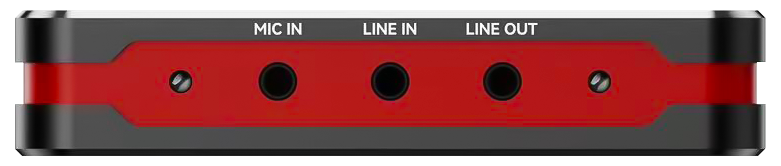
The TC-UB660 and TC-UB620 audio inputs include HDMI, a 3.5 mm line in (TRS 3-pole), and a 3.5 mm headset microphone input (CTIA 4-pole). Audio outputs include HDMI and a 3.5 mm headset earphone output (CTIA 4-pole). The supplied documentation states that microphone audio and HDMI audio can be captured with superimposition. The TC-200N9 supports embedded SDI audio synchronous acquisition and output for audio-video synchronization.
Both USB cards use a UVC (USB Video Class) and UAC (USB Audio Class) plug-and-play, driver-free architecture. UVC and UAC conformance is a declaration in its own right: it tells the buyer that the device will be recognized by the host operating system without a proprietary driver, and it defines the class-level descriptors that the host will use. The supplied documentation confirms UVC and UAC compliance for the TC-UB620, and states that the TC-UB660 uses the same UVC/UAC architecture.
Operating system compatibility is part of the declaration package because it affects the intended use environment. The TC-UB620 and TC-UB660 are documented as supporting Windows, macOS, Linux, Android, and iOS. The TC-200N9 is documented as compatible with Windows and macOS mainstream computer systems, with plug-and-play adaptation to OBS, vMix, Premiere, and After Effects. These claims should be read as the supplier’s stated compatibility, not as a guarantee that every software version or host configuration has been tested.
UVC and UAC: What Conformance Does and Does Not Cover
UVC and UAC conformance simplifies the integration path, but it does not replace regional market-access requirements. The UVC standard allows a capture card to function as a plug-and-play camera without proprietary drivers. The UAC standard does the same for audio. For a buyer, the practical benefit is predictability: the device should enumerate as a standard class device, and the host should load its built-in class driver.
However, UVC/UAC conformance is not a CE mark, an FCC declaration, or a safety certificate. It is an interface-level conformity that sits alongside the regional requirements. A product can be fully UVC/UAC compliant and still fail an EMC test if its enclosure, grounding, or cable shielding is inadequate. Conversely, a product can hold all the regional certificates but have a flawed UVC descriptor that causes it to fail enumeration on certain hosts. The two layers are complementary, not interchangeable.
For the TC-UB620, the supplied documentation explicitly states compliance with the USB Video Class (UVC) standard and the USB Audio Class (UAC) standard. For the TC-UB660, the documentation describes a UVC/UAC plug-and-play, driver-free architecture. Buyers should request the class descriptor report or a UVC/UAC test summary if the deployment depends on a specific host stack.
Safety Certifications and Warranty Coverage as Evidence
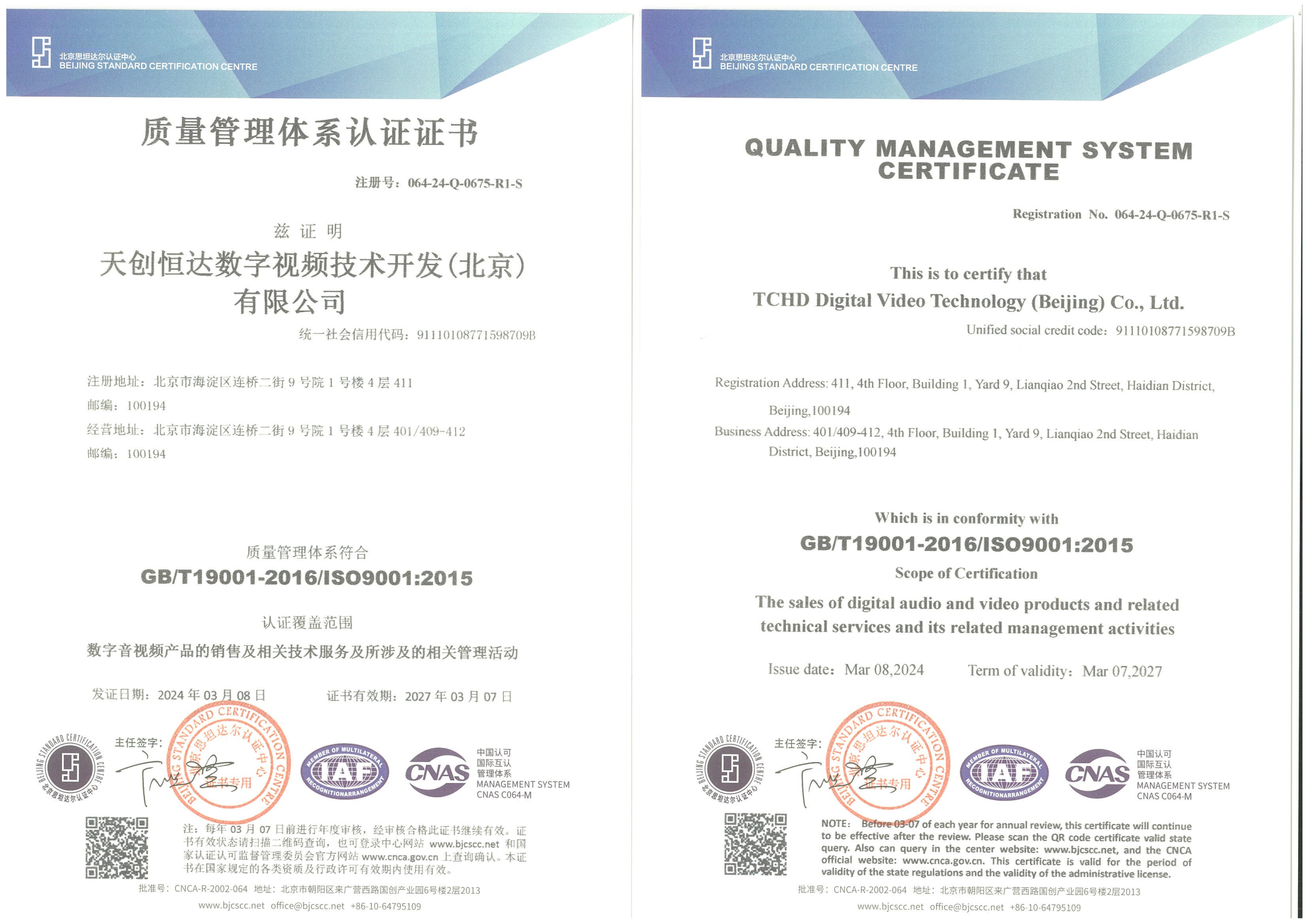
Mainstream safety certifications are part of the evidence base that a buyer can use to assess a supplier’s compliance maturity. TCHD Video’s management system certificates include:
- ISO 9001:2015 quality management system certificate, number 064-24-Q-0675-R1-S, issued by BEIJING STANDARD CERTIFICATION CENTRE, valid through 2027-03-07.
- ISO 14001:2015 environmental management system certificate, number 064-24-E-0676-R1-S, valid through 2027-03-07.
- ISO 45001:2018 occupational health and safety management system certificate, number 064-24-S-0677-R1-S, valid through 2027-03-07.
These certificates cover “the sales of digital audio and video products and related technical services and its related management activities.” They are management system certificates, not product certificates. They indicate that the supplier has documented processes for quality, environmental control, and occupational safety, but they do not by themselves certify that a specific capture card meets a specific product standard. The product-level evidence sits in the test reports, declarations of conformity, and certificate schedules that name the actual model.
Warranty coverage is the commercial counterpart to compliance. The TC-200N9 documentation states that the product is covered by a standard after-sales warranty for daily commercial and industrial long-term use. The USB cards are described as supporting continuous long-time streaming operation, which is a durability claim rather than a warranty term. Buyers should ask for the written warranty statement, including duration, coverage scope, and the geographic regions in which service is available. A warranty that is valid only in the manufacturing country may not support a deployment in the EU or North America without additional arrangements.
Step-by-Step: How to Verify Regional Compliance Before You Buy
The following sequence is a practical verification path for a buyer or integrator. It does not replace a formal legal review, but it reduces the risk of accepting a compliance file that looks complete but does not cover the actual product.
Step 1: Define the destination markets and the installation context
List every country or region where the capture card will be placed on the market or put into service. For each, note whether the product is sold as a standalone unit, embedded in a larger system, or used internally by an organization. The obligations can differ. For example, a card imported into the EU for internal testing may have different documentation requirements than one placed on the market for sale.
Step 2: Map each market to its applicable directives and standards
For the EU, identify the applicable EMC, safety, RoHS, and WEEE obligations. For the US, identify the FCC equipment authorization category and the applicable safety standard. For Asia-Pacific, identify the local marking scheme and scope rules. Use the official registers and the standards’ current editions, not summaries from secondary sources.
Step 3: Request the product-specific declaration of conformity
Ask for the declaration of conformity or equivalent attestation that names the exact model and hardware revision. Check that the declared standards are the ones applicable to that model, not to a different product in the same family. For TCHD Video, the CE EMC certificate LCSA07075157E is scoped to the TC-400N4 HDMI series; a buyer evaluating the TC-UB620, TC-UB660, or TC-200N9 should request the corresponding product-level documents for those models.
Step 4: Verify the technical file contents
The technical file should include the product description, block diagram, circuit diagram or layout reference, bill of materials, test reports, and the declaration of conformity. Check that the housing material, interface types, power characteristics, and supported resolutions in the technical file match the product datasheet and the physical sample. For the TC-UB620 and TC-UB660, the aluminum alloy housing and USB 3.2 Gen 2 or USB-C 3.2 Gen 1 interface should appear consistently across all documents.
Step 5: Check the standards’ editions and transition dates
Standards are revised. A certificate that cites an obsolete edition may still be accepted during a transition period, but it will eventually need updating. Confirm the edition cited in the test report and compare it with the current harmonised standard list for the destination market. The CE EMC certificate for the TC-400N4 series cites EN 55032:2015/A1:2020 and EN 55035:2017/A11:2020; buyers should verify whether those editions remain current for their target market at the time of purchase.
Step 6: Confirm the scope covers the shipped configuration
A certificate for a card without the audio cable, without the specific power adapter, or without the retail packaging may not cover the configuration you are buying. Check whether accessories are included in the scope. For bus-powered USB cards, the host power delivery is part of the operating condition; for PCIe cards, the host slot power is part of the condition. The declaration should state any assumptions about the host environment.
Step 7: Verify the warranty and after-sales terms for the destination region
A compliance file is not complete without a service path. Confirm the warranty duration, the party responsible for service in the destination region, and the process for firmware or driver updates. For OEM/ODM projects, clarify whether the compliance documentation will be transferred in the buyer’s name or remains with the manufacturer.
Use Cases: How Regional Compliance Touches Real Deployments
EU integrator deploying a multi-camera streaming rack
An integrator building a rack for a corporate client in Germany needs CE marking and a declaration of conformity for each capture card in the bill of materials. The TC-UB620’s HDMI 2.0 and USB-C 3.2 Gen 1 interfaces are documented, and its aluminum alloy housing is declared. The integrator should verify that the specific card revision carries a CE EMC declaration covering the EN 55032 and EN 55035 standards, and that the RoHS declaration covers the housing and cable materials. The UVC/UAC conformance simplifies the Windows and macOS driver story, but it does not replace the CE file.
US-based esports venue recording game consoles
A venue recording 4K gameplay on the TC-UB660 benefits from the HDMI 2.1 pass-through at 2160p144 and the USB 3.2 Gen 2 capture at up to 3840 × 2160 at 144 fps using MJPG. For FCC purposes, the card is an unintentional radiator and should be assessed against Part 15 Class B limits if marketed for residential or office use. The venue operator should ask for the FCC declaration or the test report that supports it, and confirm that the VRR pass-through behaviour (including the documented YCbCr420 limitation) is accurately described in the user documentation.
Medical training lab using SDI capture
A hospital training lab using the TC-200N9 for SDI capture should verify the product’s safety certification and its EMC behaviour in the presence of other medical electrical equipment. The TC-200N9 documentation states that it is certified with mainstream safety certifications and covered by a standard after-sales warranty. The lab should obtain the specific certificate numbers and confirm that the standards cited are appropriate for the installation environment. The fact that the card is driver-free and compatible with Windows and macOS reduces the software validation burden, but it does not change the electrical safety review.
Comparison Table: Regional Compliance Checkpoints
The table below summarizes the checkpoints a buyer should verify for each major market. It is a planning aid, not a substitute for the official legal texts or the product’s actual declaration.
| Region / Market | Primary marking / scheme | Typical EMC standards cited | Typical safety / substance scope | What to verify for a 4K capture card |
|---|---|---|---|---|
| European Union | CE marking | EN 55032 (emissions), EN 55035 (immunity) | EN 62368-1 safety family, RoHS, WEEE | Declaration of conformity naming the exact model; RoHS test summary; WEEE registration where applicable |
| United States | FCC Part 15 (unintentional radiator) | FCC Part 15 Subpart B, Class B limits | UL or equivalent NRTL safety certification | FCC declaration or test report; safety certificate for the enclosure and power path |
| United Kingdom | UKCA marking | Designated standards aligned with EU EN 55032 / EN 55035 | UK safety and RoHS equivalents | UKCA declaration; confirmation that the EU certificate is accepted or duplicated |
| Australia / New Zealand | RCM marking | AS/NZS CISPR 32 (emissions) | AS/NZS 62368-1 safety family | RCM declaration; responsible supplier registration |
| Japan | PSE (where applicable), VCCI | VCCI Class B limits | PSE technical standards for specified products | Confirm whether the card falls within PSE scope; VCCI compliance statement |
| South Korea | KC marking | KC EMC standards | KC safety standards | KC certificate naming the model; local responsible party |
| China | CCC (where in catalogue) | GB/T 9254 series | GB 4943.1 safety standard | CCC certificate if applicable; CTA declaration for interfaces |
What Buyers Should Verify Region by Region
Beyond the table, a few practical checks apply across markets:
- Model-level traceability. The certificate or declaration should name the exact model (for example, TC-UB620 or TC-UB660), not just a generic product family. A family certificate may be acceptable if the model is listed in the schedule, but the linkage must be explicit.
- Standard edition currency. Check that the cited standard edition is still harmonised or accepted in the destination market. Transition periods vary by region.
- Housing and material declarations. The aluminum alloy housing on the USB cards and the PCB material on the TC-200N9 should be reflected in the RoHS and safety documentation. If the housing material changes between production batches, the declaration should be updated.
- Power architecture consistency. Bus-powered USB cards and PCIe cards have different safety and EMC test setups. Confirm that the test setup matches the way the product will be installed.
- Interface claims. HDMI 2.1 and USB 3.2 Gen 2 claims should be supported by the test report or the interface compliance certificate. If the product documentation says “HDMI 2.1 enabled,” verify what that means in terms of supported formats and bandwidth.
- Warranty and service location. A warranty that is administered only from the manufacturing country may add cost and delay for a European or North American deployment. Confirm the service path before the purchase order.
Need the full technical file for a specific model? TCHD Video’s product catalog provides an overview of the capture card range and related video hardware. You can download it here: TCHD Product Catalog 2025 (PDF). For model-specific certificates, test reports, and declaration schedules, contact the supplier directly and specify the exact model and destination market.
FAQ
Are Chinese 4K capture card manufacturers compliant with CE and RoHS?
Compliance is product-specific and certificate-specific, not a general attribute of a manufacturing country. Some Chinese manufacturers hold CE EMC certificates, RoHS test reports, and ISO management system certificates; others may hold only a subset. TCHD Video, for example, holds a CE EMC Attestation of Compliance (LCSA07075157E) scoped to the TC-400N4 HDMI series, plus ISO 9001, ISO 14001, and ISO 45001 management system certificates. The TC-200N9 product documentation states that it is certified with mainstream safety certifications. A buyer should request the product-level CE declaration, the RoHS test summary, and the certificate schedule that names the exact model being purchased. Do not assume that a management system certificate or a family certificate automatically covers every model in the catalog.
Does UVC/UAC conformance remove the need for CE or FCC certification?
No. UVC and UAC are USB class specifications that define how video and audio devices enumerate and communicate with the host. They help ensure driver-free operation across Windows, macOS, Linux, Android, and iOS, but they do not address electromagnetic emissions, electrical safety, or hazardous substances. A UVC/UAC-compliant capture card still needs the applicable regional market-access declarations. The TC-UB620 documentation confirms UVC and UAC compliance; the TC-UB660 documentation describes a UVC/UAC plug-and-play architecture. Both still require the regional compliance file for the destination market.
How can a buyer verify that a certificate covers the exact capture card model?
Look for the model name or model family in the certificate schedule or the declaration of conformity. If the certificate lists only a series name, check whether the specific model is included in the series scope. For TCHD Video, the CE EMC certificate LCSA07075157E is scoped to the TC-400N4 HDMI series; a buyer evaluating the TC-UB620, TC-UB660, or TC-200N9 should request the corresponding document for those models. Also check the hardware revision: a certificate issued for an earlier revision may not cover a later change in housing material, interface, or power architecture.
What is the difference between an aluminum alloy housing and a PCB housing for compliance?
The housing material affects flammability, thermal behaviour, and substance restrictions. An aluminum alloy housing, as used on the TC-UB620 and TC-UB660, is inherently non-combustible and provides heat dissipation during continuous streaming. A PCB-based card, such as the TC-200N9, relies on the board material and the enclosure design for those functions. In the technical file, the housing material should be declared and matched to the safety and RoHS assessments. If the housing material changes between production batches, the declaration should be reviewed and updated.
How does warranty coverage relate to regional compliance?
Warranty is a commercial term, but it is part of the buyer’s risk assessment. A product that is compliant for the destination market but has no service path in that region can still create operational risk. The TC-200N9 documentation states that it is covered by a standard after-sales warranty for daily commercial and industrial long-term use. Buyers should confirm the warranty duration, the responsible service party in the destination region, and whether firmware or driver updates are included. For OEM/ODM projects, clarify whether the compliance documentation and warranty obligations transfer to the buyer’s entity or remain with the manufacturer.
Conclusion
Regional compliance for a 4K capture card is a documentation discipline as much as a testing discipline. The hardware details—housing material, interface type, power architecture, and supported signal formats—must be accurately declared and consistently reflected across the datasheet, the test report, and the declaration of conformity. The TC-UB620, TC-UB660, and TC-200N9 illustrate how those details differ across a product family: aluminum alloy versus PCB, USB 3.2 Gen 2 versus USB-C 3.2 Gen 1 versus SDI, bus-powered versus PCIe-powered. The buyer’s job is to verify that the compliance file matches the exact model and revision being purchased, that the standards cited are current for the destination market, and that the warranty and service path support the deployment. UVC/UAC conformance and OS compatibility are useful evidence, but they sit alongside the regional requirements—not in place of them.
Have Questions or Need More Details?
Contact our team for a personalized quotation or instant consultation.
Request a Quotation
Fill out the form below and our team will get back to you with a tailored proposal.
WhatsApp Direct Chat
Prefer to chat in real-time? Message us on WhatsApp for instant assistance & quick answers.
- Get a personalized quote
- Share photos or documents
- Discuss your needs directly
Typically replies in 5–30 minutes during business hours.