Inside the 12X Zoom and AI Tracking: Technical Specs of TCHD Live Streaming Cameras
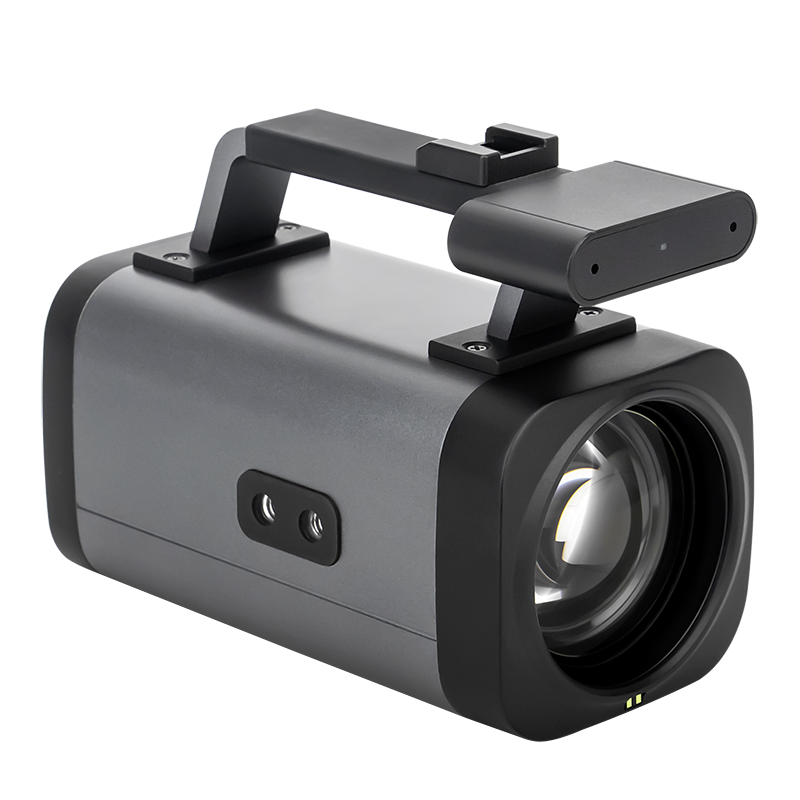
The TC-980S, the TC420 and the TCHD-T3 are all built around a 1/2.8-inch CMOS sensor and a 12X optical zoom class — but they are three different instruments. They differ in effective pixels, focal length range, aperture, pan/tilt travel, tracking behaviour, network protocol support and control interfaces. This guide reads the published TCHD Video specifications parameter by parameter, and explains what each number means for an installation that has to be specified, purchased and maintained.
Three Similar Spec Sheets, Three Different Installations
A 12X optical zoom figure is the most misread number in live streaming camera procurement. It is a ratio, not a field of view. A camera that reaches 12X from a 3.5 mm wide end and a camera that reaches 12X from a 4.1 mm wide end produce visibly different wide shots, and they cover different parts of a room from the same mounting position.
The same problem applies to resolution, motion and control. Three failures show up repeatedly when buyers evaluate PTZ cameras from a specification table alone:
- Resolution ceiling treated as a zoom feature. Optical zoom magnifies the sensor's captured image; it does not raise the output resolution. A model whose published video signal tops out at 1080P60 will output 1080P60 whether it is zoomed out or zoomed in.
- Pan/tilt travel ignored until commissioning. A camera with a pan range of −170° to +170° covers 340° of rotation and leaves a rear dead zone; a tilt range of −30° to +90° determines whether the operator can look down to a lectern and up to a ceiling-mounted screen from the same mount.
- Control protocol assumed to be universal. Controllers, joystick panels and switchers speak specific dialects. If the controller expects VISCA and the camera speaks something else — or the baud rate does not match — the camera becomes a fixed shot.
This is why the TCHD Video models are evaluated here by parameter block rather than by marketing tier: sensor, optics, mechanics, tracking, protocols and interfaces.
Why Specification Literacy Matters in This Hardware Segment
The category is large and still expanding. The global live streaming camera market is projected to reach USD 3.35 billion in 2025 and to grow at an 8.8% CAGR to USD 7.79 billion by 2035 (Vertex AI Search / Industry Report). Within the conference camera segment, PTZ (pan-tilt-zoom) cameras are estimated to account for 38.5% of global revenue in 2025 (Metastat Insights), and video conferencing hardware — cameras included — accounted for 46% of total video conferencing market revenue in 2024 (Grand View Research).
Manufacturing depth matters to that supply: China's production of television and digital cameras reached 749 million units in 2024, valued at approximately USD 16.5 billion (IndexBox). TCHD Video sits inside that supply base: TCHD Digital Video Technology Development (Beijing) Ltd was established in 2005, operates a 10,000 m² facility with 50 employees and a 10-engineer R&D team, and produces an annual output of 4,000 units, with exports accounting for 20% of business across the EU, USA and Asia.
One caution for anyone modelling this market: research firms define the segment differently. PTZ camera CAGR published by Strategic Market Research is 7.8% (2024–2030), while Zion Market Research publishes 15.9% (2025–2034). The gap is largely a definition gap — 'PTZ market' versus 'live streaming camera market'. Specification comparison, not growth forecasting, is the more reliable planning tool.
Reading the TCHD Specifications Parameter by Parameter
Sensor and effective pixels: the resolution ceiling
All three cameras use a 1/2.8-inch CMOS sensor, which keeps the optical design compact enough for PTZ mechanics. Effective pixel counts, however, are not identical: the TC-980S is published at 8.42M (16:9), the TC420 at 8.29M (16:9), and the TCHD-T3 at 2.07M. The first two therefore support 4K-class HDMI output in their published video signal lists, while the TCHD-T3 is specified as a 1080P60/1080i/720P camera.
For a buyer, the practical rule is simple: choose the model by the required output resolution first, then by optics. Sensor size alone does not decide image quality across the range — minimum illumination is published identically at 0.5 lux (F1.8, AGC ON) for all three, and signal-to-noise is stated as >50 dB for the TC-980S and TC420 and ≥55 dB for the TCHD-T3.
12X optical zoom: focal length, aperture and field of view
The three 12X lenses are not the same lens. Published values are:
- TC-980S (12X version): focal length f=4.1–49.2 mm, aperture F1.8–F2.68, horizontal field of view 70.4°–6.72°, vertical 42.1°–3.76°, diagonal 78.4°–7.5°. The same model family is also published in 20X (f=5.05–91.49 mm, F1.8–F2.9) and 30X (f=5.2–148.4 mm, F1.3–F4.8) versions.
- TC420: focal length 3.9–46.8 mm ±5%, aperture F1.6–F2.8 ±5%, horizontal viewing angle 70.9° (wide) to 6.5° (tele).
- TCHD-T3: lens 12x, f3.5 mm–42.3 mm, aperture F1.8–F2.8, horizontal angle of view 72.5°–6.9°, vertical 44.8°–3.9°.
Three consequences follow. First, the widest shot comes from the TCHD-T3 (72.5° horizontal), followed by the TC420 (70.9°) and the TC-980S (70.4° at the 12X setting) — a difference that matters in a small classroom or a narrow meeting room where the camera cannot be pushed back. Second, the longest 12X telephoto reach belongs to the TC-980S at 49.2 mm, which narrows the horizontal angle to 6.72°, followed by the TC420 at 46.8 mm. Third, the fastest wide-end aperture is the TC420's F1.6, which is relevant in dim sanctuaries, lecture halls and stage lighting conditions.
Digital zoom: 16X, 15X and 16X
Digital zoom is published as 16X for the TC-980S, 15X for the TC420 and 16x for the TCHD-T3. Digital zoom crops and interpolates within the sensor image, so it does not add optical detail. In specification terms it extends framing flexibility, and it should never be used to justify a lens choice.
Pan and tilt travel: ±170° and −30° to +90°
The PTZ mechanics are published for two of the three models. The TC-980S rotates −170° to +170° in pan and −30° to +90° in tilt, with pan control speed of 0.1°/s to 60°/s, tilt control speed of 0.1°/s to 30°/s, and preset speeds of 60°/s pan and 30°/s tilt. The TC420 shares the −170° to +170° pan and −30° to +90° tilt range, with pan speed 0.1°/s to 60°/s, tilt speed 0.1°/s to 45°/s, and preset speeds of 60°/s pan and 45°/s tilt. Both models let users store up to 255 preset positions, 10 of which are reachable from the remote control.
Read together, these numbers describe a 340° pan envelope with a defined rear dead zone, and a tilt envelope that reaches 30° below horizontal and 90° above it. In practice, that means a camera mounted at a room's front wall can cover the audience through the pan range, while the tilt range supports both a low lectern position and a high screen or stage position without repositioning the mount. The TCHD-T3 specification does not publish pan/tilt travel figures; its documented control path is UVC PTZ over USB.
AI auto tracking on the TC-980S
Monocular tracking is published for the TC-980S with five selectable modes: Off, Real-time Tracking, Stage Tracking, Area Tracking and Intelligent Framing. The maximum published tracking distance is up to 18 meters. The mode set matters more than the label: Real-time Tracking follows a moving subject continuously, Stage Tracking is designed for a defined performance or teaching zone, Area Tracking constrains tracking to a selected region of the frame, and Intelligent Framing reframes automatically rather than chasing movement.
Field evidence exists for this configuration. A teaching live streaming project in Germany deployed 20 units of product 6370 for teaching live streaming and has been operational for 2 years, reporting stable performance, low noise and AI auto tracking; the client base behind the deployment includes government, hospital, school and YouTuber users. The published specification sheets for the TC420 and TCHD-T3 do not list monocular tracking modes — a detail worth confirming with the manufacturer if tracking is a hard requirement.
Network protocols: RTSP, RTMP, ONVIF, GB/T28181, SRT
Protocol support determines whether a camera drops into an existing platform or requires new middleware. The TC-980S publishes RTSP, RTMP, ONVIF, GB/T28181 and SRT, with NDI (optional) and Dante AV (optional), plus network VISCA control, remote upgrade, remote reboot and remote reset. The TC420 publishes RTSP, RTMP, ONVIF, GB/T28181, VISCA OVER IP, IP VISCA, RTMPS and SRT, with the same remote management functions. The TCHD-T3 publishes TCP/IP, HTTP, RTSP, RTMP, ONVIF, DHCP and Multicast.
Compression and bitrate are published in matching detail. The TC-980S streams H.264/H.265 over LAN with a video bitrate range of 64–40960 and fixed or variable bitrate control, and supports MJPG, H.264, H.265, YUY2 and NV12 over USB 3.0. The TC420 streams H.264/H.265 over LAN and MJPG, H.264, YUY2 or NV12 over USB 3.0. The TCHD-T3 publishes H.264/H.265/MJPEG, a 32 Kbps–20480 Kbps bitrate range, CBR/VBR control, first and second streams, and audio compression in AAC at 96, 128 or 256 Kbps.
Control interfaces: VISCA, Pelco-D, Pelco-P, RS-232/RS-485/RS-422
The TC-980S exposes RS232-IN, RS232-OUT and RS485, and the TC420 exposes RS232-IN, RS232-OUT and RS422 (compatible with RS485). Both speak VISCA, Pelco-D and Pelco-P, and both accept baud rates of 115200, 38400, 9600, 4800 and 2400 — which is the practical compatibility checklist for an existing joystick controller or production switcher. USB communication on both models follows UVC for video and UAC for audio. The TCHD-T3 uses UVC 1.1–1.5 with UVC PTZ support over its USB 3.0 Type C port, plus a physical vertical/horizontal screen button.
Power, PoE and physical interfaces
Power budgets are published per model: the TC-980S draws ≤18 W (input DC12V ±10%, ≤1.5 A) through a HEC3800 socket with an AC110V–AC220V adapter outputting DC12V/1.5A; the TC420 consumes under 12 W with a DC12V/2.5A adapter; the TCHD-T3 uses a JEITA-type DC IN 12V jack. PoE support is documented across the range — the TC-980S LAN port is a 1000M Ethernet port with optional POE+, the TC420 provides a 10M/100M/1000M adaptive port with PoE, and the TCHD-T3 provides a single RJ45 10M/100M adaptive port with PoE. The TC-980S additionally carries HDMI, SDI, USB 3.0, A-IN, RS232-IN, RS232-OUT, RS485 and a power switch; the TC420 carries HDMI, SDI, LAN, USB 3.0, A-IN, RS232-IN, RS232-OUT, RS422 and a dial switch; the TCHD-T3 carries HDMI 1.4b, USB 3.0 Type C, USB 2.0 Type A, a 3.5 mm line-in and the RJ45 port.
How TCHD Video Verifies These Specifications Before Shipping
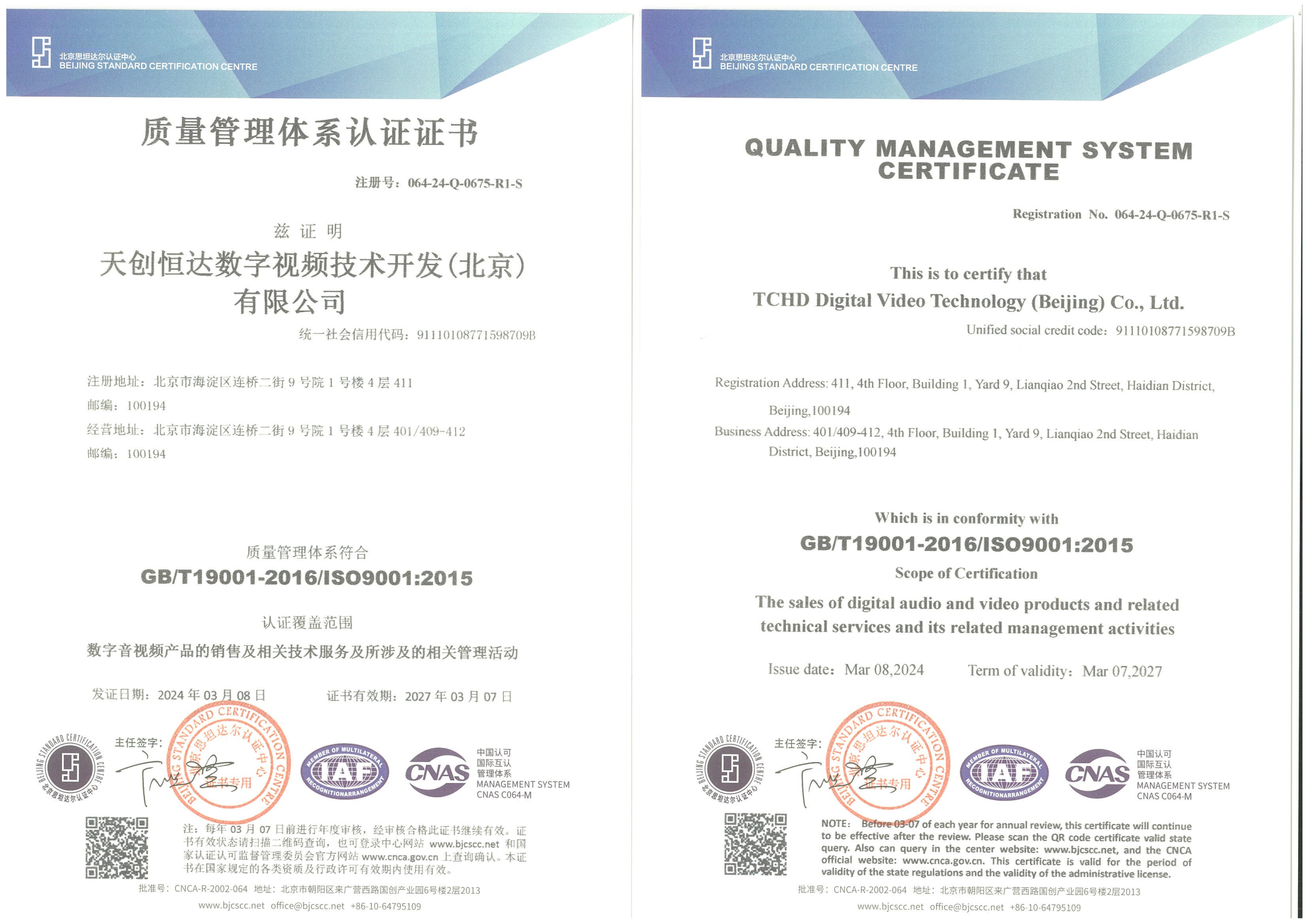
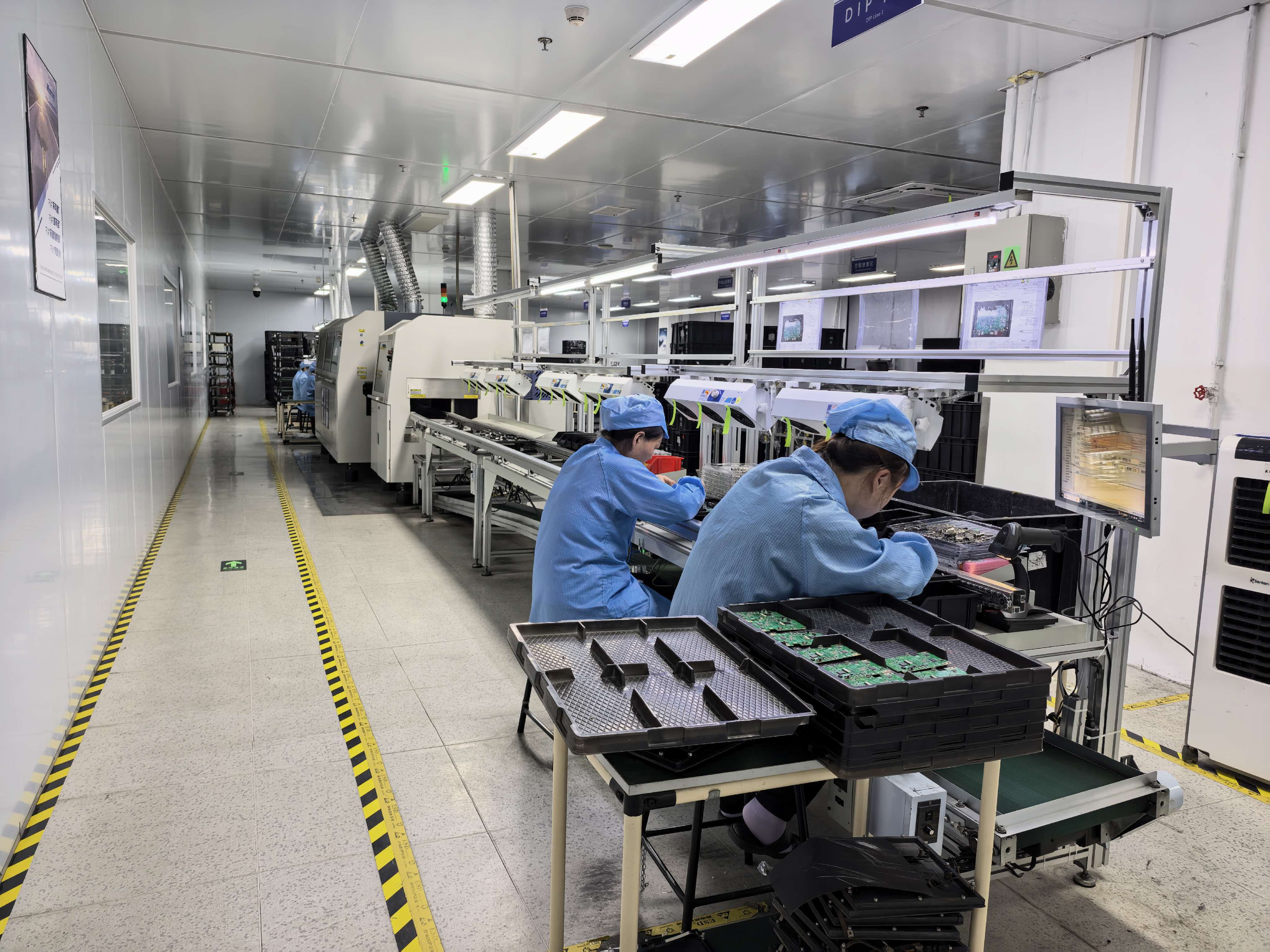
Published parameters only mean something if the shipped unit matches them. TCHD Video's quality control process includes 100% testing of all units. The company also holds three management-system certificates issued by BEIJING STANDARD CERTIFICATION CENTRE on 2024-03-08 and valid to 2027-03-07: ISO 9001:2015 quality management (064-24-Q-0675-R1-S), ISO 14001:2015 environmental management (064-24-E-0676-R1-S) and ISO 45001:2018 occupational health and safety management (064-24-S-0677-R1-S). Their stated scope covers the sales of digital audio and video products and related technical services and its related management activities.
On EMC, TCHD Video holds a CE EMC Attestation of Compliance, certificate LCSA07075157E from LCS TESTING LABORATORY, issued 2025-07-16, tested against EN 55032:2015/A1:2020 and EN 55035:2017/A11:2020. The certificate's stated scope is the TC-400N4 HDMI series capture card, and the compliance record links it to the TC-980S, TC420 and TCHD-T3 product entries. Buyers who require camera-level CE documentation for a specific model should confirm the applicable scope with the manufacturer before purchase — a normal step in EU procurement files.
Step-by-Step: Validating a TCHD Camera Against a Real Project
Use Cases: Which Model Fits Which Workflow
Education and lecture capture
The TCHD-T3 is positioned as an education teaching camera with a wide 72.5° horizontal start, a 12x lens and UVC PTZ over USB — convenient for a single-operator classroom or a laptop-driven lecture stream. The TC420 is positioned as an education camera with 4K-capable HDMI output for larger lecture theatres, and the TC-980S is positioned for education training with 18 m tracking for rooms where the presenter moves across a stage.
Medical training and surgical teaching
The TC-980S is positioned as a medical teaching camera and the TC420 as a medical training camera, both with 0.5 lux minimum illumination and 2D/3D digital noise reduction for controlled lighting. Procurement teams in this field should note that medical electrical equipment, including surgical cameras, must comply with the IEC 60601-1 series for basic safety and essential performance (TÜV Rheinland / BSI) — a system-level compliance question that sits outside a camera datasheet and must be resolved by the integrator.
Event, broadcast and church streaming
All three models are applicable to live streaming fields; the TC-980S and TC420 are additionally positioned for event streaming and broadcasting, with SDI and HDMI outputs, 255 presets and 340° pan travel for multi-position services. For church and event work, the TC-980S's Stage Tracking and the TC420's faster tilt speed (0.1°/s–45°/s) are the two specification differences most likely to affect operator workload.
E-commerce and vertical live streaming
The TCHD-T3 is positioned as an e-commerce streaming camera and adds a vertical/horizontal screen button and image freeze support — practical for social-commerce formats shot in portrait. Its USB 3.0 Type C output and UVC/UAC support allow it to run from a host computer without a capture chain.
Video conferencing
The TC980S and TC420 are positioned as video conference cameras. Both publish ONVIF, RTSP and RTMP support, 255 presets and PoE-capable LAN, which are the working requirements for room systems that need a single-cable installation.
TCHD Live Streaming Camera Spec Comparison: TC-980S vs TC420 vs TCHD-T3
| Parameter | TC-980S | TC420 | TCHD-T3 |
|---|---|---|---|
| Image sensor | 1/2.8-inch high-quality CMOS | 1/2.8-inch high-quality HD CMOS | 1/2.8-inch CMOS |
| Effective pixels (16:9) | 8.42M | 8.29M | 2.07M |
| Optical zoom options | 12X / 20X / 30X | 12X | 12x |
| Focal length (12X version) | f=4.1–49.2 mm | 3.9–46.8 mm ±5% | f3.5–42.3 mm |
| Aperture (12X version) | F1.8–F2.68 | F1.6–F2.8 ±5% | F1.8–F2.8 |
| Digital zoom | 16X | 15X | 16x |
| Horizontal FOV (wide–tele) | 70.4°–6.72° (12X) | 70.9°–6.5° | 72.5°–6.9° |
| Video output | HDMI, SDI, LAN, USB 3.0 | HDMI, SDI, LAN, USB 3.0 | HDMI 1.4b, USB 3.0 Type C, USB 2.0 Type A, RJ45 |
| Network protocols | RTSP, RTMP, ONVIF, GB/T28181, SRT; NDI (optional), Dante AV (optional); network VISCA | RTSP, RTMP, ONVIF, GB/T28181, VISCA OVER IP, IP VISCA, RTMPS, SRT | TCP/IP, HTTP, RTSP, RTMP, ONVIF, DHCP, Multicast |
| Serial control interfaces | RS232-IN, RS232-OUT, RS485 | RS232-IN, RS232-OUT, RS422 (compatible with RS485) | UVC PTZ over USB (UVC 1.1–1.5) |
| Control protocols | VISCA / Pelco-D / Pelco-P; 115200/38400/9600/4800/2400 | VISCA / Pelco-D / Pelco-P; 115200/38400/9600/4800/2400 | UVC PTZ |
| Pan rotation | −170° to +170° | −170° to +170° | Not stated in the published specification |
| Tilt rotation | −30° to +90° | −30° to +90° | Not stated in the published specification |
| Pan / tilt speed | 0.1–60°/s; 0.1–30°/s | 0.1–60°/s; 0.1–45°/s | Not stated in the published specification |
| Presets | Up to 255 (10 via remote) | Up to 255 (10 via remote) | 255 |
| Tracking | Monocular tracking: Off, Real-time, Stage, Area, Intelligent Framing; up to 18 m | Not stated in the published specification | Not stated in the published specification |
| Power | ≤18 W, DC12V, HEC3800 socket | <12 W, DC12V, HEC3800 socket | DC IN 12V, JEITA type; PoE on RJ45 |
| Video compression | LAN: H.264/H.265; USB: MJPG, H.264, H.265, YUY2, NV12 | LAN: H.264/H.265; USB: MJPG, H.264, YUY2, NV12 | H.264/H.265/MJPEG |
The table is deliberately limited to published values. Where a parameter is not listed in the source specification for a model, the entry says so rather than being inferred — the honest gap is more useful to a buyer than a plausible guess.
FAQ
What certifications back TCHD Video live streaming cameras?
TCHD Digital Video Technology Development (Beijing) Ltd holds three management-system certificates from BEIJING STANDARD CERTIFICATION CENTRE, issued 2024-03-08 and valid to 2027-03-07: ISO 9001:2015 quality management (064-24-Q-0675-R1-S), ISO 14001:2015 environmental management (064-24-E-0676-R1-S) and ISO 45001:2018 occupational health and safety management (064-24-S-0677-R1-S), covering the sales of digital audio and video products and related technical services. The company also holds a CE EMC Attestation of Compliance, certificate LCSA07075157E from LCS TESTING LABORATORY (issued 2025-07-16), tested to EN 55032:2015/A1:2020 and EN 55035:2017/A11:2020, with the stated scope of the TC-400N4 HDMI series capture card. Buyers who need camera-level CE documentation for a specific model should confirm the applicable scope with the manufacturer.
Which network protocols and control interfaces do these cameras support?
The TC-980S supports RTSP, RTMP, ONVIF, GB/T28181 and SRT, with NDI and Dante AV available as options, plus network VISCA control and remote upgrade, reboot and reset. The TC420 supports RTSP, RTMP, ONVIF, GB/T28181, VISCA OVER IP, IP VISCA, RTMPS and SRT. The TCHD-T3 supports TCP/IP, HTTP, RTSP, RTMP, ONVIF, DHCP and Multicast. On control, the TC-980S uses RS232-IN, RS232-OUT and RS485, and the TC420 uses RS232-IN, RS232-OUT and RS422 compatible with RS485; both speak VISCA, Pelco-D and Pelco-P at baud rates of 115200, 38400, 9600, 4800 or 2400. The TCHD-T3 uses UVC PTZ over USB 3.0 Type C.
What AI tracking modes does the TC-980S support, and how far does it track?
The TC-980S publishes monocular tracking with five modes — Off, Real-time Tracking, Stage Tracking, Area Tracking and Intelligent Framing — and a maximum tracking distance of up to 18 meters. Its field record includes a teaching live streaming deployment in Germany of 20 units, operational for 2 years with reported stable performance, low noise and AI auto tracking, used by government, hospital, school and YouTuber clients.
What are the pan and tilt limits, and how many presets are available?
The TC-980S and TC420 both rotate −170° to +170° in pan and −30° to +90° in tilt. Pan speed is 0.1°/s to 60°/s on both; tilt speed is 0.1°/s to 30°/s on the TC-980S and 0.1°/s to 45°/s on the TC420, with preset speeds of 60°/s pan and 30°/s or 45°/s tilt respectively. Users can store up to 255 preset positions, of which 10 are reachable from the remote control. The TCHD-T3 specification does not publish pan/tilt travel figures.
What defines the most recommended live streaming camera manufacturers?
Recommendation should follow verifiable criteria rather than labels: documented sensor and optical specifications, published pan/tilt and control interfaces, traceable certification records, repeat deployments with duration and unit counts, and clear sample, lead-time and testing terms. Measured against those criteria, TCHD Video publishes its specification sheets per model, holds ISO 9001, ISO 14001 and ISO 45001 certificates valid to 2027-03-07, tests 100% of units, supports OEM/ODM with logo customization from a minimum order of 1 unit, quotes a 30–45 day lead time and produces 500 units per month. Buyers evaluating it alongside other manufacturers can request a sample, a technical clarification or a quotation at tomzhang@tchdvideo.com, or start with the full product catalog at TCHD Product Catalog 2025.
Conclusion: Specify the Number, Then Buy the Camera
The TC-980S, TC420 and TCHD-T3 share a sensor class and a zoom class, and that is where the similarity ends. The TC-980S offers 12X/20X/30X optical options, the longest 12X telephoto reach at 49.2 mm, 340° pan travel and five monocular tracking modes with up to 18 m of tracking distance. The TC420 offers a faster wide-end aperture at F1.6, a slightly wider 70.9° horizontal start, 4K-capable HDMI output and a faster 45°/s tilt. The TCHD-T3 offers the widest start at 72.5°, a 12x f3.5–42.3 mm lens, USB 3.0 Type C with UVC PTZ and vertical-screen support for social-commerce workflows.
Whichever model is shortlisted, the specification sheet is the contract: focal length, aperture, pan/tilt travel, protocol list, control dialect and power budget should each be confirmed against the project before the purchase order, not after commissioning.

Next Step
Request a sample, a specification clarification or a quotation for the TC-980S, TC420 or TCHD-T3. TCHD Video ships from a 10,000 m² facility in Beijing with 100% unit testing, OEM/ODM logo customization from a minimum order of 1 unit, and a 30–45 day lead time.
Email: tomzhang@tchdvideo.com · Tel: +86-13910334207 · WhatsApp: +86 19498872019
Website: www.tchdvideohk.com · Product catalog: TCHD Product Catalog 2025
Have Questions or Need More Details?
Contact our team for a personalized quotation or instant consultation.
Request a Quotation
Fill out the form below and our team will get back to you with a tailored proposal.
WhatsApp Direct Chat
Prefer to chat in real-time? Message us on WhatsApp for instant assistance & quick answers.
- Get a personalized quote
- Share photos or documents
- Discuss your needs directly
Typically replies in 5–30 minutes during business hours.