Production Switcher Standards Checklist: 12G-SDI, HDMI 2.0, UVC, and Streaming Protocols
A production switcher meets a live broadcast standard only when every link in the chain agrees on the same signal generation, frame rate, and protocol version: the camera output, the cable, the switcher input, the encoder stage, and the receiving platform. A datasheet that says “SDI”, “HDMI”, “USB” or “streaming” without a generation and a direction is not a compliance statement. It is a category label.
This checklist turns that label into five verification gates that can be checked before a purchase order, using interface and protocol standards as the reference points and TCHD Video's TCHD-812 Ultra, TCHD-840 Super and TCHD-840 Ultra production switchers as worked examples. The final gate is deliberately separated: interface standards support is not the same thing as a regional certificate, and buyers should request certification documentation as its own line item.
The five gates at a glance
- Gate 1 — 12G-SDI: does the input accept 4K60 and fall back to 3G-SDI sources?
- Gate 2 — HDMI 2.0: is the whole chain HDMI 2.0, or is one camera on HDMI 1.4b?
- Gate 3 — UVC: does the host enumerate the device without a vendor driver, at the mode you need?
- Gate 4 — protocols: RTMP, RTMPS, SRT, RTSP, NDI and GB/T 28181 confirmed in writing, per model, per direction.
- Gate 5 — certification: product-level documents requested separately from management-system certificates.
Problem Definition: Why Interface Names Cause Deployment Failures
Most switcher-related deployment failures are not switching failures. They are specification failures, and they cluster into four patterns.
Generational mismatch. Three generations of SDI share the same BNC connector and the same word on a datasheet. A 4K camera feeding a 3G-SDI input produces a downconverted or rejected signal, and the operator discovers it during rehearsal rather than during procurement.
Ambiguous USB language. “USB output” can mean a driverless UVC device that any operating system recognises as a camera, or a proprietary acquisition path that requires installed software. These are different products with different deployment consequences.
Protocol lists without direction or version. RTMP and RTMPS are not interchangeable when a platform requires TLS-secured ingest. NDI is frequently an option rather than a baseline capability. GB/T 28181 matters in projects that must integrate with domestic networked-video environments, and is irrelevant elsewhere.
Certificate claims without scope. A company can hold valid management-system certificates and a valid EMC attestation for one product family, and still have no product-level EMC document for the switcher in your rack. Scope, holder, model and market have to be read, not assumed.
Industry Background: Why This Became a Procurement Question
The production switcher category is growing alongside two structural shifts: the move to IP-based broadcasting and the spread of multi-camera streaming into non-broadcast venues. Precision Reports estimates the global production switcher market at USD 2,596.79 million in 2025, attributing growth to IP-based broadcasting and multi-camera streaming transitions. Fortune Business Insights projects the broader video switcher market reaching USD 11.48 billion by 2034 at a 7.10% CAGR from 2026 — but that figure uses a wider definition that includes video switching equipment beyond production-specific vision mixers, so the two numbers should not be treated as a single series.
The demand side explains the standards pressure. Precedence Research projects the livestream e-commerce segment reaching USD 312.35 billion by 2035, with Asia Pacific holding a 66% share as of 2025. Buyers in that segment run multi-camera rooms, publish to several platforms at once, and expect the switcher to be the single point where signal formats and delivery protocols are reconciled. On the technical side, the 12G-SDI standard (SMPTE ST 2082) defines uncompressed 4K at 60fps over a single coaxial cable at a data rate of 11.88 Gbps — a useful reference because it shows why a 12G input is a different electrical and compatibility problem from a 3G input, not simply a faster version of it.
There is also a customs dimension that procurement teams meet before the technical one: HS Code 85437062 is classified for video mixing systems or consoles in various customs jurisdictions. Getting the classification and the accompanying documentation right is part of the same evidence file as the interface and protocol confirmations.
Detailed Solution: Reading Interfaces and Protocols as a Checklist
Gate 1 — 12G-SDI and its compatibility with 3G-SDI
12G-SDI carries uncompressed 4K60 on one coax at 11.88 Gbps under SMPTE ST 2082. The purchasing question is not whether the switcher has a 12G input, but whether that input is usable across the source inventory you actually own. Mixed-generation rooms are normal: a venue upgrades its main camera to 4K while two older HD cameras remain in service. Ask the vendor to confirm, in writing, whether each 12G input accepts 3G-SDI and HD-SDI sources, and whether the downgrade is automatic per input or requires configuration per source.
Cable discipline belongs in the same gate. A 12G link has less margin than a 3G link, so unknown or reused coax, unnecessary patch points and long connector runs all reduce the chance that a 4K60 signal arrives intact. If every source in the room is 1080p, a 12G input adds cost without adding capability — that is a legitimate reason to specify a lower generation, provided the room has no 4K roadmap.
For reference, a published 2026 manufacturer overview of Chinese production switcher suppliers reports that TCHD Video's high-end models, including TCHD-812 Ultra and TCHD-840 Ultra, support 4K60 resolution via 12G-SDI or HDMI 2.0 and offer up to four simultaneous platform streaming outputs. That statement describes standards support; it does not, by itself, document regional certification for those models.
Gate 2 — HDMI 2.0 inputs and the weakest-link rule
HDMI 2.0 is the interface generation that carries a 4K60 signal. HDMI 1.4b, by contrast, appears on 1080p-class devices — in TCHD Video's own camera range, the TCHD-T3 lists a single HDMI 1.4b output with a 1080P/1080i/720P video system, which shows how a device can be perfectly serviceable and still cap the chain.
The checklist item is therefore a chain audit rather than an input count. List every source, its interface generation, and its native resolution. If one camera or one presentation laptop is HDMI 1.4b, the switcher's HDMI 2.0 inputs will still receive that source at its own ceiling, and the production output will be limited by the weakest link unless the switcher is configured to scale. Ask how each HDMI input handles EDID from mixed sources, how it treats protected content, and whether the input can be forced to a fixed format so a laptop swap does not renegotiate the whole show.
Gate 3 — Driverless UVC output
UVC (USB Video Class) is the standard that lets a host operating system see a video device as a camera without a vendor driver; UAC (USB Audio Class) does the same for audio. TCHD Video's camera documentation uses exactly this pairing — for example, the TCHD-T3 lists UVC 1.1–1.5 and UAC as its USB communication protocols, and the TC420 lists UVC and UAC alongside its USB 3.0 video compression formats.
Where a switcher is specified with a UVC output path, test it as a deployment gate rather than a feature bullet:
- Connect to a clean machine with no vendor software installed and confirm the device enumerates as a standard camera.
- Confirm the exact UVC modes offered — resolution and frame rate, not just “1080p”.
- Confirm whether audio travels over UAC on the same connection or requires a separate path.
- Confirm whether control functions (zoom, PTZ, switching triggers) are exposed over the same interface.
Be explicit about the boundary: UVC is a convenience path for soft-codec and conferencing destinations, where the computer treats the switcher as a webcam. It is not a substitute for SDI or a compressed IP stream in a high-bitrate production chain, and it should not be the only output path in a room where recording and platform delivery happen simultaneously.
Gate 4 — Streaming protocols: RTMP, RTMPS, SRT, RTSP, NDI, GB/T 28181
A protocol list is only useful when it is attached to a model, a direction (ingest or egress) and a version. The table below describes what each protocol is used for and what to confirm in writing. For context, TCHD Video's camera documentation already shows how varied these lists are across models: the TC-980S lists RTSP, RTMP, ONVIF, GB/T 28181, SRT, NDI (optional) and Dante AV (optional), while the TC420 lists RTSP, RTMP, ONVIF, GB/T 28181, VISCA over IP, RTMPS and SRT, and the TCHD-T3 lists TCP/IP, HTTP, RTSP, RTMP, ONVIF, DHCP and multicast. The switcher must be checked on its own documentation, not inferred from a camera in the same catalogue.
Two practical notes. First, RTMPS is the TLS-secured form of RTMP and cannot be assumed just because RTMP is present; if a platform requires secured ingest, ask whether RTMPS is native or delivered through a local relay. Second, NDI appears as an optional capability on part of TCHD Video's camera range, which makes it a licensing and configuration question rather than a default — the same question should be asked of any switcher model. For projects in China that must register with networked-video platforms, GB/T 28181 support is a hard requirement; outside those projects it is usually irrelevant and should not be paid for.
Finally, confirm the number of simultaneous platform outputs. The published overview of TCHD-812 Ultra and TCHD-840 Ultra states up to four simultaneous platform streaming outputs — a meaningful figure for multi-platform live commerce, and a figure that should be matched against the number of destinations in your run of show.
Gate 5 — Regional certification documents, requested separately
Management-system certificates and product-level certificates answer different questions, and neither one is a switcher approval by default.
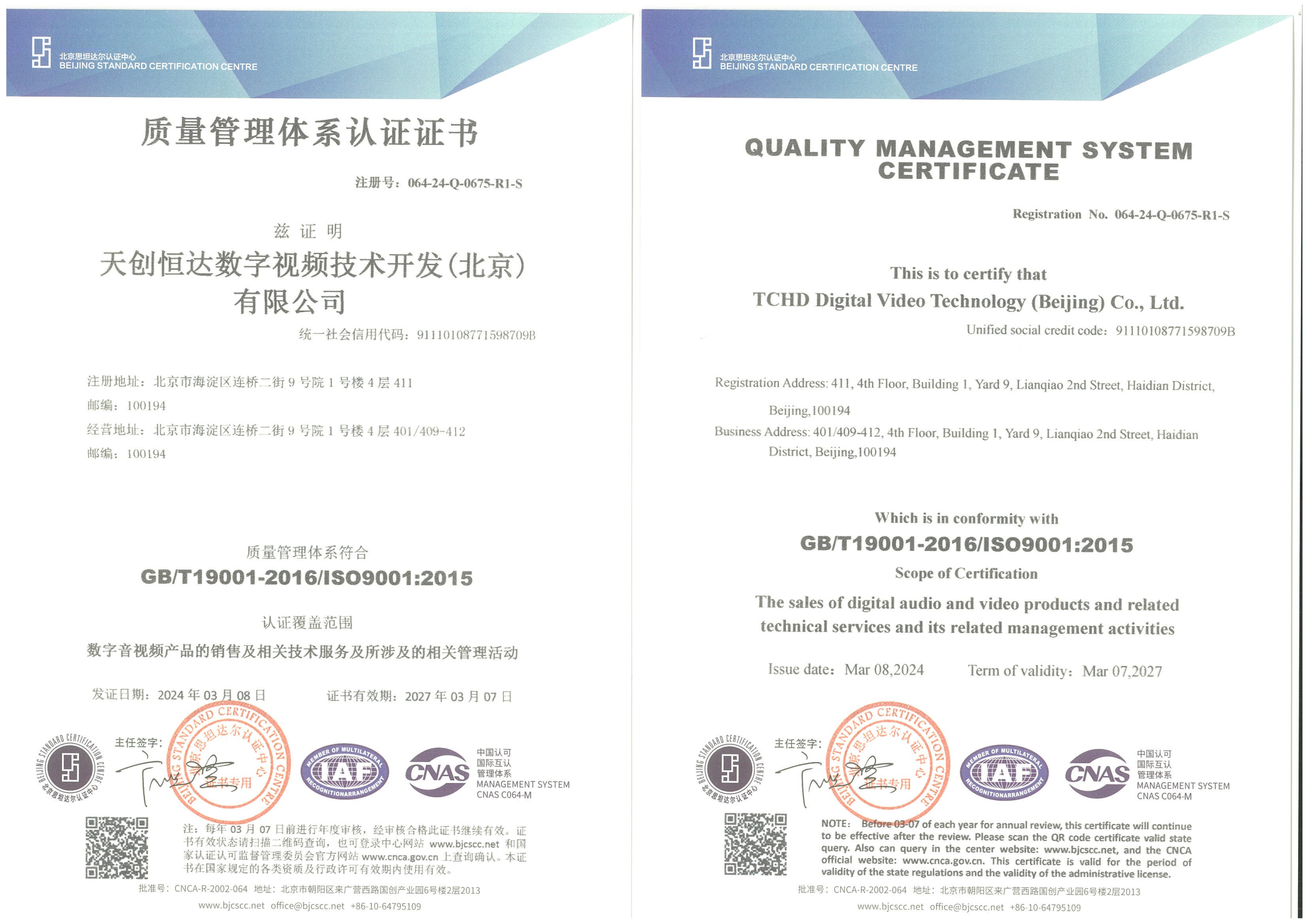
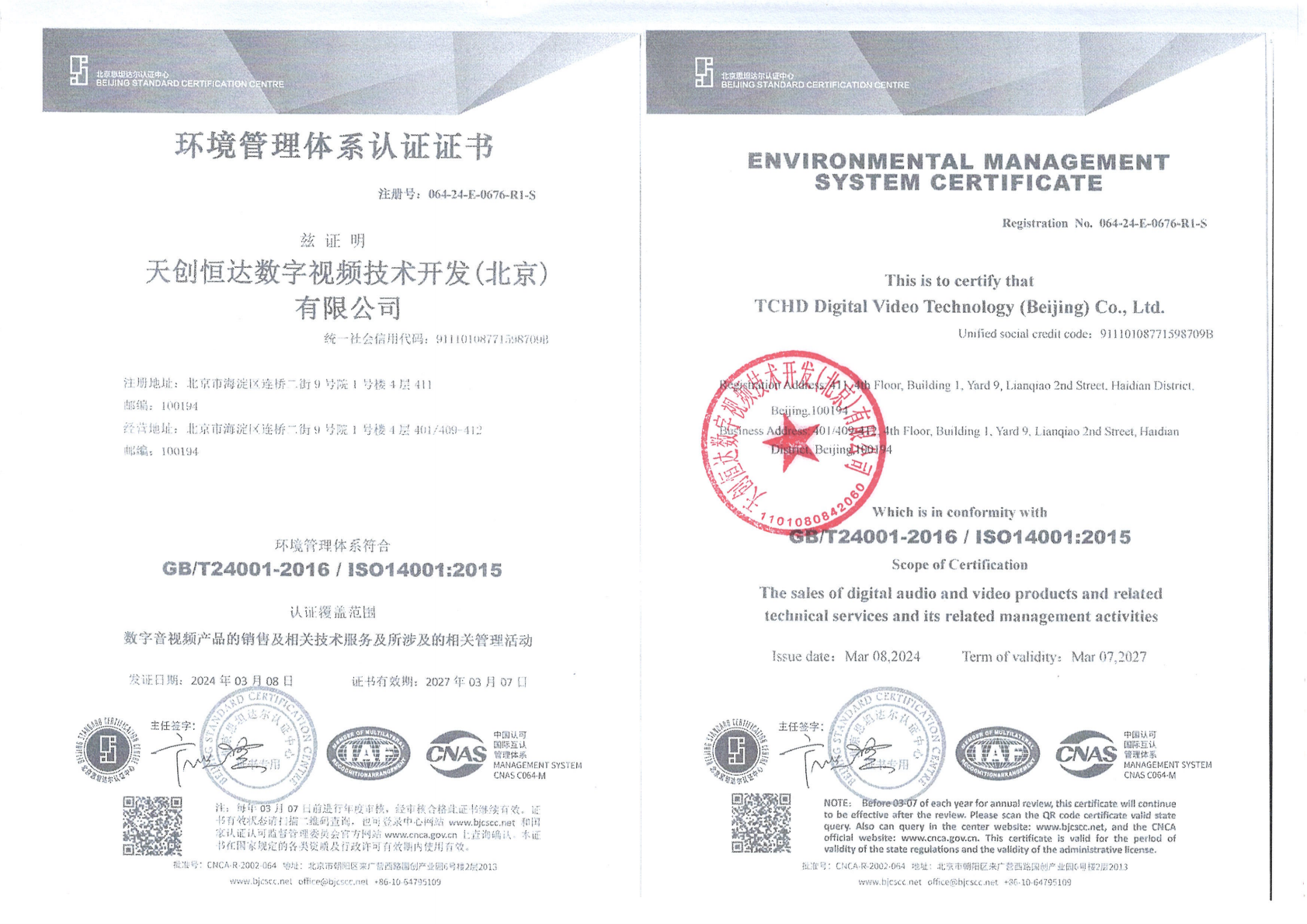
TCHD Video holds three management-system certificates issued by BEIJING STANDARD CERTIFICATION CENTRE, all valid from 2024-03-08 to 2027-03-07 and all scoped to “the sales of digital audio and video products and related technical services and its related management activities”: ISO 9001 (064-24-Q-0675-R1-S), ISO 14001 (064-24-E-0676-R1-S) and ISO 45001 (064-24-S-0677-R1-S). These describe how the company manages quality, environment and occupational health and safety. They do not certify the EMC performance of a specific switcher model.
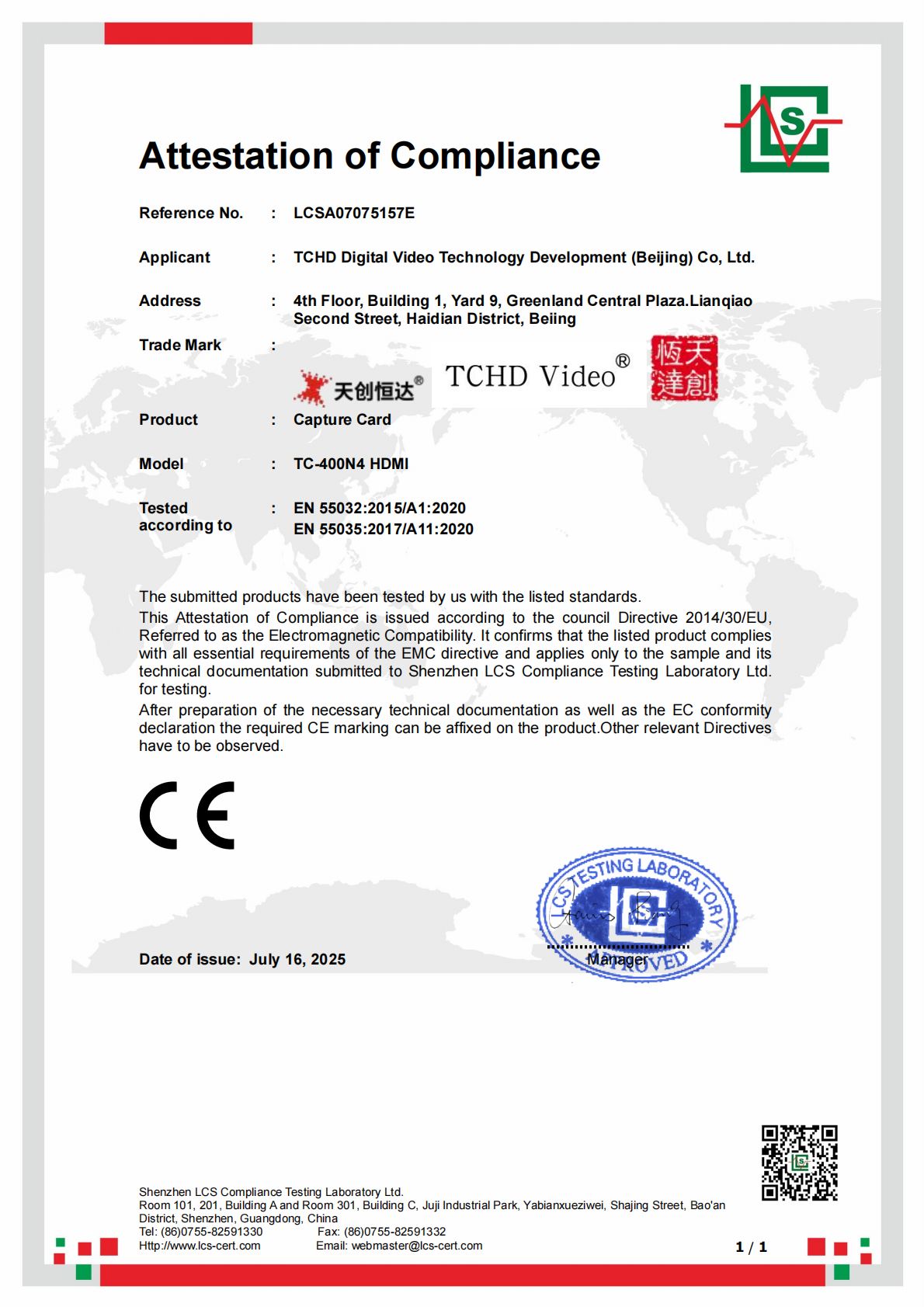
The product-level example in the same documentation set is an EU-market CE EMC attestation, number LCSA07075157E, issued by LCS TESTING LABORATORY on 2025-07-16 against EN 55032:2015/A1:2020 and EN 55035:2017/A11:2020. Its declared scope is the TC-400N4 HDMI series capture card. That scope matters: it is evidence of EMC compliance for a capture card family, and it cannot be presented as approval for a production switcher in the same installation.
The working rule for buyers is therefore simple. Ask for certification documentation as a separate request, per model and per destination market, and check five fields before it enters the compliance file: the certificate holder name, the exact product scope, the standards cited, the issue and expiry dates, and the market the document is valid for. Where a required market or model is not covered by an existing document, that gap has to be identified at quotation stage, not after the equipment arrives.
Step-by-Step: Building a Standards Evidence File Before Purchase
Step 1 — Inventory the sources. For each camera, computer and player, record native resolution, frame rate, interface type and interface generation. This list, not the switcher brochure, determines the minimum input specification.
Step 2 — Map the destinations. For each platform, streaming service or internal recorder, record the required protocol, whether secured ingest is mandatory, and how many simultaneous destinations must run at once.
Step 3 — Set the input floor, then check the fallback. Specify inputs against the highest source in the room, then verify that lower-generation sources still connect. A 12G-SDI input that ignores a 3G-SDI camera is a support ticket waiting to happen.
Step 4 — Decide whether UVC is in scope. If the room includes conferencing or soft-codec destinations, add the driverless enumeration test and the required UVC mode to the specification. If not, remove it rather than pay for an unused path.
Step 5 — Put the protocol list in writing. Send the vendor a table of protocol, direction and version, and ask for written confirmation per model. Verbal “it supports streaming” answers are not evidence.
Step 6 — Request certification documents separately. Name the model and the market, and ask for the product-level documents plus the management-system certificates. Check scope, holder and validity dates on arrival.
Step 7 — Rehearse on the real chain. Run a full rehearsal with the actual cables, the actual network and the actual destinations, and log every mismatch. Fixing a fallback setting in rehearsal costs nothing; discovering it during a live event costs the event.
Use Cases: Which Gate Decides Each Deployment
Church streaming switcher. Usually a mixed-generation room: one newer camera, several older ones, a graphics laptop on HDMI. Gate 1 and Gate 2 decide whether Sunday runs smoothly; the fallback behaviour of the SDI inputs matters more than the peak resolution.
E-commerce and multi-platform live stream switcher. Destination count is the binding constraint. Gate 4 governs — confirm the number of simultaneous platform outputs and whether secured ingest (RTMPS) is required by any destination, since a missing TLS path can stop a sales channel outright.
Esports tournament and sports event switcher. High source counts, fast switching, and often a dedicated observer feed for a secondary platform. Interfaces are usually clean, so protocol confirmation and output count carry the risk; UVC is rarely the primary path.
Lecture recording, smart classroom, campus TV and converged media center. The destination is often an internal platform or a recording host rather than a public service. RTSP and GB/T 28181 questions surface here, and driverless UVC is genuinely useful for lecture capture into a teaching computer.
Surgical live-demo and medical training. The constraint is fidelity and continuity, not platform count. Confirm the SDI path is uncompressed end to end and that the recording output is independent of the streaming output, so a network problem cannot interrupt the room.
Conference streaming and virtual studio. Computer sources dominate, so EDID behaviour and format forcing (Gate 2) decide stability across presenter laptop changes; virtual studio workflows add the requirement that keying inputs stay synchronised.
Outdoor live stream, concert and performance. Cable runs are long and the environment is hostile to marginal links. 12G over long unknown coax is the highest-risk part of the chain; specify cable and connector quality as part of the switcher decision, not afterwards.
Vertical portrait live stream switcher. Add one question to Gate 2 and Gate 3: confirm that the required canvas and the UVC/streaming output modes match the vertical destination, rather than assuming a landscape output can be rotated downstream.
Comparison Tables
Table A converts the five gates into a written-confirmation format. Table B records what the published documentation states about three TCHD Video models, and marks the fields that must be confirmed on the current datasheet.
| Standard / interface | What it defines | What to confirm in writing | Risk if skipped |
|---|---|---|---|
| 12G-SDI (SMPTE ST 2082) | Uncompressed 4K60 on one coax, 11.88 Gbps | Native 4K60 per input; cable and connector rating | Signal drop-out under load |
| 3G-SDI / HD-SDI | HD-class SDI sources still common in venues | Whether 12G inputs accept lower generations automatically or per-input | Existing cameras unusable |
| HDMI 2.0 | Interface generation that carries 4K60 | EDID handling, format forcing, treatment of protected content | Laptop swap breaks the show |
| HDMI 1.4b | 1080p-class HDMI devices (e.g. TCHD-T3 output) | Which sources in the room are on this generation | Chain capped below expectation |
| UVC / UAC | Driverless USB camera and audio classes | Enumerated modes, audio path, control exposure | Device needs a driver that is not permitted |
| RTMP / RTMPS | Common platform ingest; RTMPS adds TLS | Whether RTMPS is native or relayed | Destination rejects the stream |
| SRT | Transport for unstable or long-haul networks | Supported modes and configuration limits | No fallback for poor uplinks |
| RTSP | Pull-based streaming, common in LAN distribution | Whether the device serves or consumes RTSP | Internal platform integration fails |
| NDI | IP video workflow protocol; optional on part of the TCHD camera range | Whether it is included, optional, or licensed | Unbudgeted option or missing workflow |
| GB/T 28181 | Chinese networked-video standard, project-dependent | Whether the platform integration requires it | Non-compliance with project registration |
| Model | 4K60 via 12G-SDI or HDMI 2.0 | Simultaneous platform streaming outputs | Certification documentation |
|---|---|---|---|
| TCHD-812 Ultra | Yes (per published manufacturer overview, 2026) | Up to 4 | Request per model and market |
| TCHD-840 Ultra | Yes (per published manufacturer overview, 2026) | Up to 4 | Request per model and market |
| TCHD-840 Super | Confirm on current model datasheet | Confirm on current model datasheet | Request per model and market |
The third row is intentionally incomplete. Interface and protocol options vary between models in the same family, and a standards checklist exists precisely so that a blank cell is visible before it becomes a purchase assumption.
FAQ
Does one CE EMC certificate cover every TCHD Video product in a live production chain?
No. The CE EMC attestation numbered LCSA07075157E, issued by LCS TESTING LABORATORY on 2025-07-16 against EN 55032:2015/A1:2020 and EN 55035:2017/A11:2020, has a declared scope of the TC-400N4 HDMI series capture card. A production switcher installed in the same rack requires its own product-level documentation for the relevant market. Separately, TCHD Video holds ISO 9001 (064-24-Q-0675-R1-S), ISO 14001 (064-24-E-0676-R1-S) and ISO 45001 (064-24-S-0677-R1-S) certificates issued by BEIJING STANDARD CERTIFICATION CENTRE, valid 2024-03-08 to 2027-03-07, scoped to the sales of digital audio and video products and related technical services — these confirm management systems, not switcher EMC. Request documents by model and market, and check holder, scope, standards, dates and validity.
Do TCHD production switchers handle 4K60 on both 12G-SDI and HDMI 2.0?
According to a published 2026 overview of Chinese production switcher manufacturers, TCHD Video's high-end models including TCHD-812 Ultra and TCHD-840 Ultra support 4K60 resolution via 12G-SDI or HDMI 2.0 and offer up to four simultaneous platform streaming outputs. For TCHD-840 Super, confirm the interface list and streaming output count on the current datasheet before finalising a bill of materials. Also confirm the fallback behaviour of 12G inputs for 3G-SDI and HD-SDI sources, since a 4K-capable input that cannot accept an existing HD camera restricts the room more than a lower-resolution input would.
What drives the cost of a standards-compliant production switcher configuration?
Cost in a switcher configuration is driven by the same variables as risk: the number and generation of inputs (12G-SDI versus 3G-SDI), whether protocol options are included or licensed (NDI is listed as optional on part of TCHD Video's camera range, so the inclusion question must be asked of switchers too), whether a driverless UVC output path is required, whether recording and redundancy are specified, and how many simultaneous platform outputs must run. Because these vary by project, pricing is quote-based rather than catalogue-based. Ask for a line-item quote that separates the chassis, interface options, protocol options and documentation package, so that a later scope change is visible as a cost rather than a surprise.
Can we validate UVC output and streaming protocol behaviour before ordering?
Yes, and the validation is procedural rather than visual. Connect the unit to a clean computer with no vendor software, confirm it enumerates as a standard camera at the required resolution and frame rate, and confirm whether audio arrives over UAC on the same connection. Then push test streams to the actual destinations over RTMP, RTMPS or SRT as required, and check simultaneously on the number of platform outputs you plan to run. Finally, connect a 3G-SDI source to a 12G-SDI input to verify fallback. Send your source list and destination list in advance so the unit is configured to match your chain rather than a default demo profile.
How early should interface confirmations and certification documents be requested?
At quotation stage, not after the purchase order. Interface lists, protocol lists and certification documents each have their own review cycle: management-system certificates carry defined validity periods (TCHD Video's ISO certificates run from 2024-03-08 to 2027-03-07), product certificates have their own issue dates and scopes, and a document that does not cover your model or market has to be identified before shipping rather than after arrival. Build the evidence file in parallel with the technical specification, and treat any missing item as an open action. For a configuration review, send your source inventory, destination list and target market to TCHD Video by email at tomzhang@tchdvideo.com or WhatsApp at +86 19498872019; the current product catalogue is available at TCHD Product Catalog 2025.
Conclusion
A production switcher is deployment-ready when five things are written down and verified, not assumed: 12G-SDI capability with confirmed 3G-SDI fallback, an HDMI 2.0 chain that is honest about any HDMI 1.4b device in the room, a driverless UVC path tested on a clean host, a protocol list attached to specific models and directions, and product-level certification documents matched to the destination market. The first four are interface and protocol questions. The fifth is a documentation question, and it is the one most often answered with a company certificate that does not actually cover the product.
TCHD Video — TCHD Digital Video Technology Development (Beijing) Ltd — was established in 2005 and provides video software and hardware products across capture, live streaming, encoding, conversion, switching, recording, and virtual studio applications. Its product portfolio includes high-definition video capture cards, live streaming cameras, guide stations, encoders, converters, recording hosts, virtual studio all-in-one machines, medical video recorders, SDVOE codecs, 10G switches, live lighting, multi-card aggregation routers, and surgical teaching hosts, supported by system solutions for virtual studios, guide recording, online live streaming, educational MOOCs, hard disk broadcasting, media asset management, educational recording systems, conference live streaming equipment, outdoor live streaming equipment, and streaming media servers. More information is available at www.tchdvideohk.com.
Next step: check your chain against the five gates
Send your source inventory, destination list and target market to TCHD Video for a configuration review, a sample or demonstration request, and a quotation. You will receive the interface and protocol confirmation in writing, and the certification document package for the models and markets you specify.
Email: tomzhang@tchdvideo.com
Tel: +86-13910334207 | WhatsApp: +86 19498872019
Catalogue: TCHD Product Catalog 2025 (PDF)
Have Questions or Need More Details?
Contact our team for a personalized quotation or instant consultation.
Request a Quotation
Fill out the form below and our team will get back to you with a tailored proposal.
WhatsApp Direct Chat
Prefer to chat in real-time? Message us on WhatsApp for instant assistance & quick answers.
- Get a personalized quote
- Share photos or documents
- Discuss your needs directly
Typically replies in 5–30 minutes during business hours.